Contents: 20 topics
- Shraddha vs Tarpan: What Is the Difference?
- Shraddha vs Pind Daan: What Is the Difference?
- Pitru Paksha vs Mahalaya: What Is the Difference?
- Mahalaya Amavasya vs Sarva Pitru Amavasya: Are They the Same?
- Pitru Paksha vs Amavasya Shraddha: How Are They Related?
- Pind Daan at Home vs Gaya: What Is the Difference?
- Tarpan at Home vs Riverbank: Traditional Context and Practical Differences
- Can Shraddha Be Performed on a Different Day If the Tithi Is Missed?
- What If You Miss Pitru Paksha Shraddha?
- What If You Do Not Know the Ancestor’s Tithi or Gotra?
- Can You Perform Shraddha for More Than One Ancestor on the Same Day?
- Can Shraddha Be Performed for Maternal Ancestors?
- Can Shraddha Be Performed for Someone Who Died Recently?
- What Should You Wear During Shraddha?
- What Should You Avoid During Pitru Paksha?
- Can Weddings or Auspicious Ceremonies Be Planned During Pitru Paksha?
- Why Is Pitru Paksha Considered a Period for Remembrance Rather Than Celebration?
- How Should a Guest Behave at a Shraddha Meal or Ritual?
- 100 Shraddha and Pitru Paksha Questions and Answers
- Shraddha and Pitru Paksha Glossary: 50 Ritual Terms and Concepts Explained
- Frequently asked questions
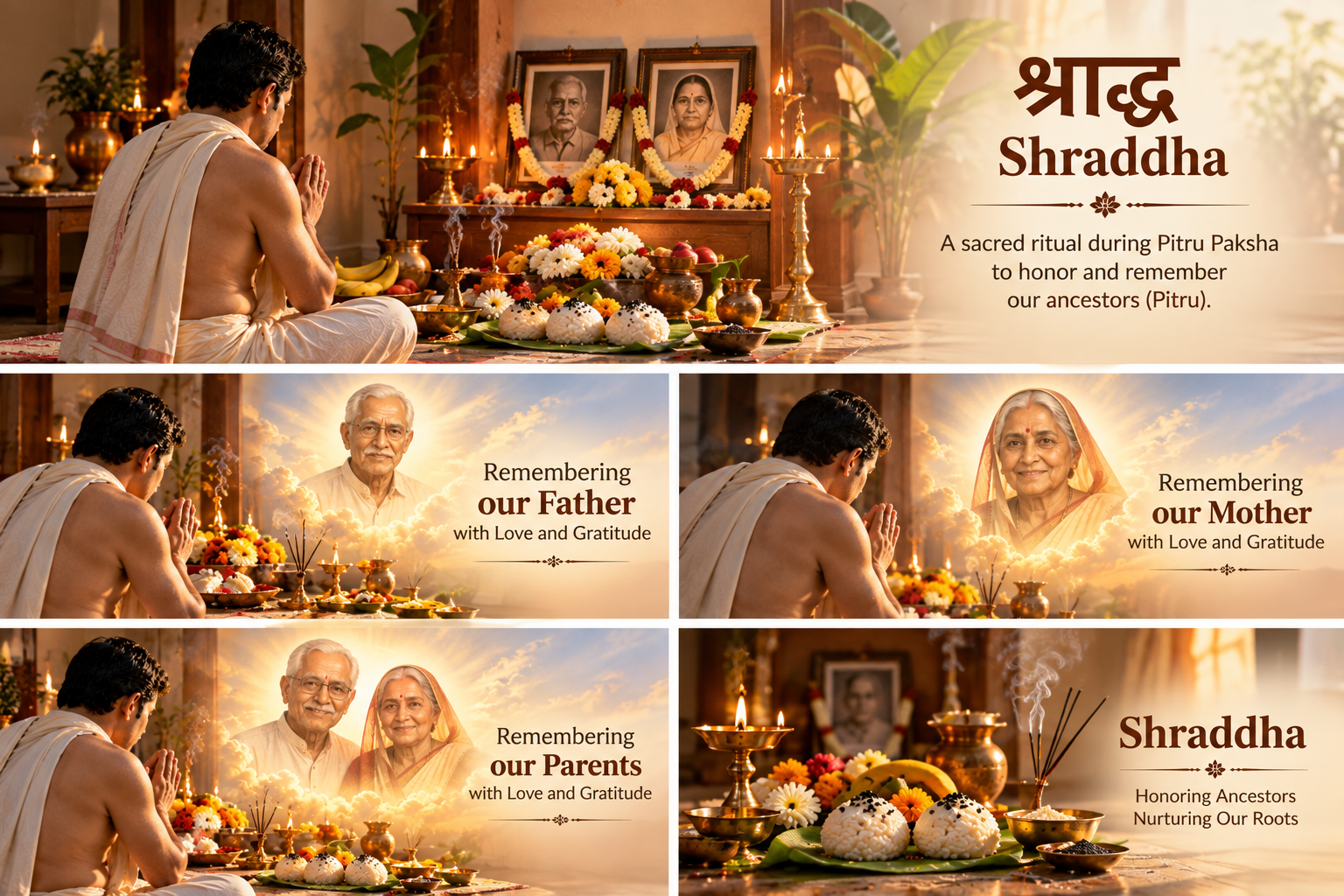
Most questions about Pitru Paksha are not about the big picture but about specifics. What is the difference between tarpan and Shraddha? Is Mahalaya the same as Sarva Pitru Amavasya? We missed the tithi, what now? Can we hold an engagement this week? What should I wear to my friend's family Shraddha?
This guide collects those questions in one place. The first half compares commonly confused terms and handles special situations; the second half offers 100 quick answers and a 50-term glossary that you can use as a reference while reading any other guide on this site.
Key takeaways
- Shraddha is the whole rite; tarpan (water and sesame) and pind daan (rice balls) are parts of it or stand-alone offerings.
- Mahalaya Amavasya and Sarva Pitru Amavasya are the same day: the new moon that closes Pitru Paksha (10 October 2026 in the New Delhi reference).
- A missed or unknown tithi is traditionally covered on Sarva Pitru Amavasya.
- Pitru Paksha is a time of restraint: weddings, housewarmings and major purchases are commonly postponed.
- After a recent death, first-year rites follow their own schedule; ask your priest before adding a Mahalaya Shraddha.
1 of 20
Shraddha vs Tarpan: What Is the Difference?
The two words are often used interchangeably, but they are not the same thing.
| Shraddha | Tarpan | |
|---|---|---|
| Meaning | A rite performed with shraddha (faith) for ancestors | "Satisfying" or "gratifying"; offering water |
| Scope | A complete ceremony: sankalpa, invocation, offerings, pinda, food, feeding a Brahmin or guests, charity | One act: offering water mixed with sesame, usually with kusha |
| Duration | An hour or more with a priest | 10 to 30 minutes |
| Who it is for | Usually specific ancestors on their tithi | Ancestors, and in fuller forms also devas and rishis |
| Frequency | Annual (tithi), Pitru Paksha, and other set occasions | Daily in some traditions, and on many occasions |
Tarpan is usually part of Shraddha, but it can also be done on its own, which is why many families who cannot perform a full Shraddha still offer tarpan every day of Pitru Paksha.
2 of 20
Shraddha vs Pind Daan: What Is the Difference?
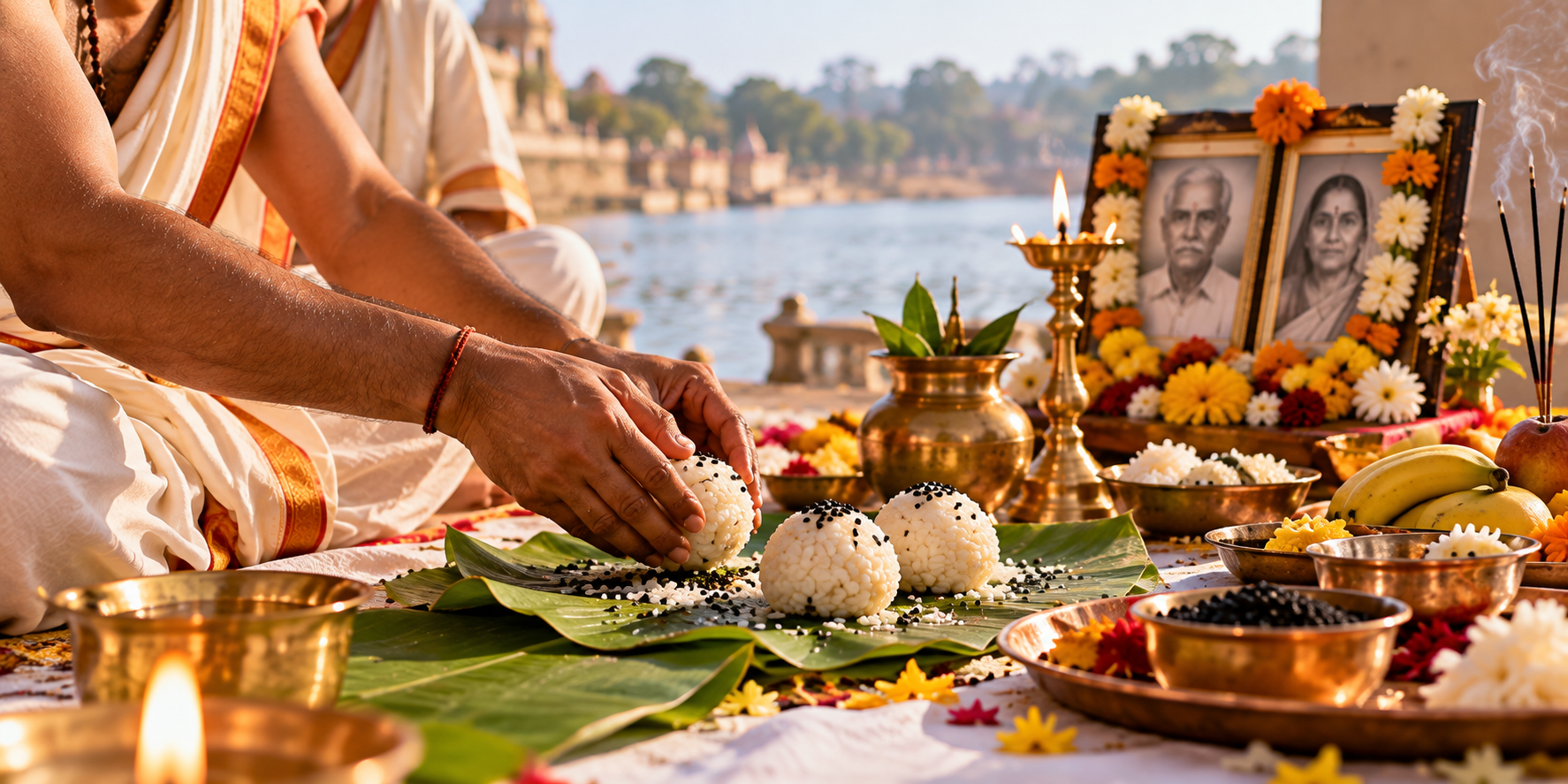
Pind daan is the offering of pindas, balls usually made of cooked rice or barley flour mixed with sesame, ghee, honey or milk, to ancestors. Shraddha is the full rite in which pind daan is commonly one component.
- In a home Shraddha, pinda offering is part of the standard sequence in many traditions, though some simplified home rites omit it.
- At pilgrimage sites, especially Gaya, pind daan is the central act, and pilgrims often speak of "doing pind daan" rather than "doing Shraddha".
- Symbolism: the pinda is widely understood as nourishing the ancestor and as a sign of the continuing bond of lineage (the word sapinda, sharing the pinda, describes close kin).
See pind daan meaning and practice and the symbolism of pindas.
3 of 20
Pitru Paksha vs Mahalaya: What Is the Difference?
Pitru Paksha is the fortnight; Mahalaya can mean either the whole fortnight or its final day, depending on region.
- In much of North India, "Pitru Paksha" or "Shraadh" names the fortnight, and the last day is Sarva Pitru Amavasya.
- In South India and Maharashtra, the fortnight is often called Mahalaya Paksha, and the last day Mahalaya Amavasya.
- In Bengal, "Mahalaya" usually means the final day itself, marked by pre-dawn tarpan and the start of Devi Paksha leading to Durga Puja.
So all three regions are talking about the same period; the vocabulary differs. See Mahalaya in Bengal vs Sarva Pitru Amavasya elsewhere.
4 of 20
Mahalaya Amavasya vs Sarva Pitru Amavasya: Are They the Same?
Yes. Both names refer to the new moon (Amavasya) at the end of Pitru Paksha. In the New Delhi 2026 reference it falls on Saturday, 10 October. Outside India, check a Panchang set to the city where the observance is performed.
- Sarva Pitru means "all ancestors": on this day Shraddha can be performed for every ancestor, including those whose tithi is unknown or was missed.
- Mahalaya is the name used in Bengal, the South and Maharashtra.
- Other regional names include Peddala Amavasya in Andhra Pradesh and Telangana.
6 of 20
Pind Daan at Home vs Gaya: What Is the Difference?
| At home | At Gaya | |
|---|---|---|
| Setting | Family home, on the ancestor's tithi | Gaya's sacred sites: Vishnupad, the Phalgu, Akshayavat and many vedis (altars) |
| Status in tradition | Standard part of household Shraddha | Held in especially high regard; the Gaya Mahatmya praises Shraddha here |
| Frequency | Can be annual | Usually once in a lifetime, or for a particular ancestor |
| Guidance | Family priest | Gayawal pandas and local priests who keep family records |
| Time and cost | A morning | One to several days, plus travel |
A Gaya pind daan does not replace annual Shraddha in most traditions; families commonly continue home observance afterwards, though some communities hold a different view. Ask your priest.
See Gaya pilgrimage guide and pind daan at home vs pilgrimage site.
7 of 20
Tarpan at Home vs Riverbank: Traditional Context and Practical Differences
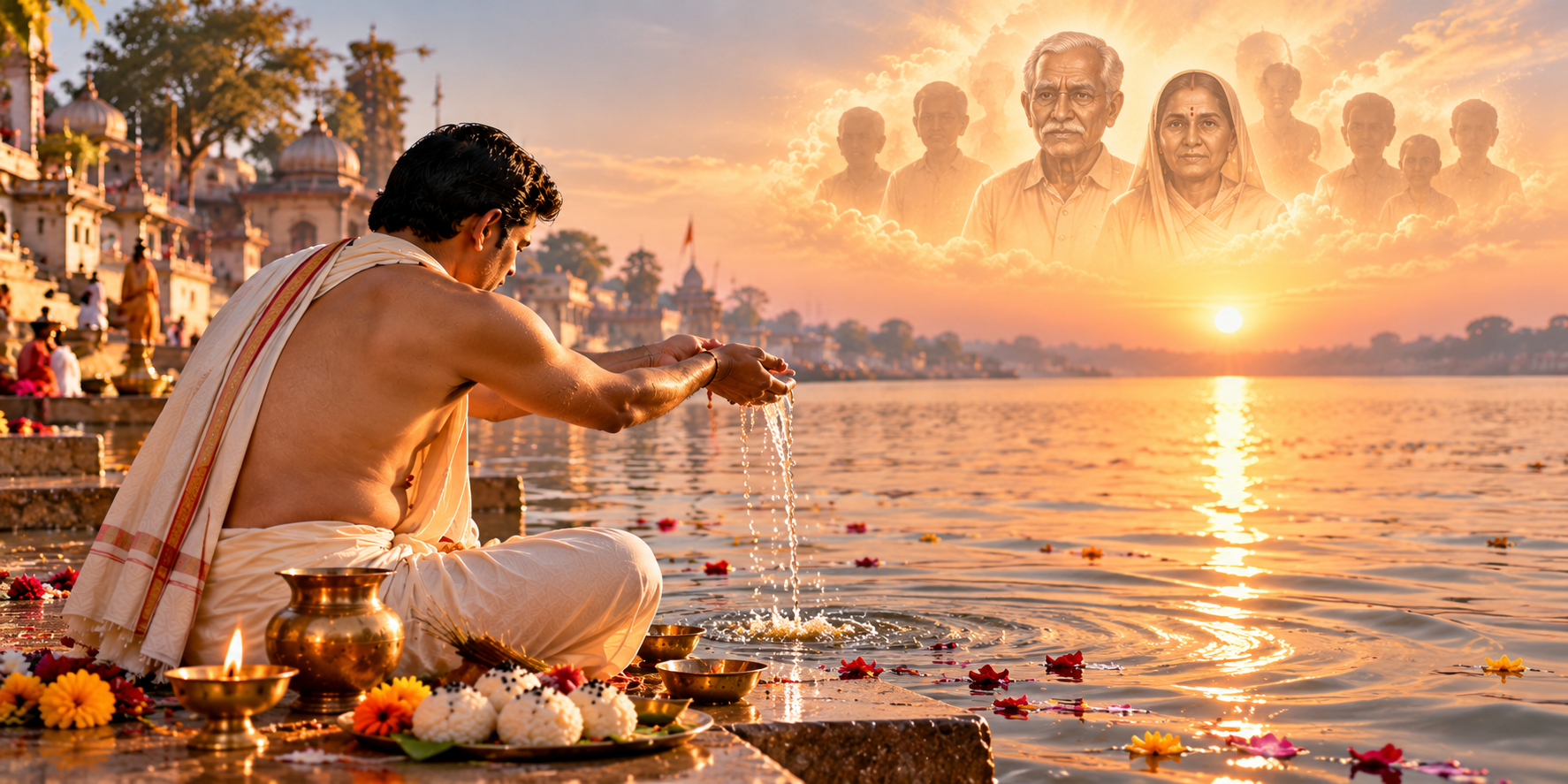
Riverbanks and tirthas have long been favoured for tarpan, because water is the medium of the offering and sacred rivers are thought to carry it. But home tarpan is equally part of tradition.
| At home | At a riverbank | |
|---|---|---|
| How water is offered | Poured from a vessel into a plate or basin | Offered directly into the river from cupped hands, often standing in the water |
| Afterwards | Water poured onto a plant or clean soil | Returns to the river |
| Advantages | Daily practice possible, private, flexible | Traditional setting, often with a priest and community |
| Considerations | Space, direction | Crowds, safety, weather, local rules on offerings and pollution |
At crowded ghats during Pitru Paksha, follow local safety instructions and avoid leaving plastic or non-biodegradable items. Abroad, see observing without a river.
8 of 20
Can Shraddha Be Performed on a Different Day If the Tithi Is Missed?
Tradition provides for this. The most common options:
- Sarva Pitru Amavasya. The main provision: Shraddha can be performed on the final day for any ancestor whose tithi was missed.
- The corresponding tithi in the next month or another Amavasya, according to some priests.
- The annual death-anniversary Shraddha (on the tithi of death in its lunar month), which is separate from Pitru Paksha and remains the other key annual occasion.
A tithi can also be "lost" in the calendar itself when two tithis fall on the same sunrise, as with Chaturthi and Panchami on 30 September 2026 in the New Delhi reference. In such cases Panchangs specify which Shraddha is observed on which day. See how the correct tithi is chosen.
9 of 20
What If You Miss Pitru Paksha Shraddha?
Missing a Shraddha is common, through illness, travel, work or simple forgetting, and tradition treats it calmly.
- Missed the tithi: perform Shraddha or tarpan on Sarva Pitru Amavasya.
- Missed the whole fortnight: many priests suggest a Shraddha or tarpan on a later Amavasya, feeding the needy, charity in the ancestors' names, or observing the annual death-anniversary Shraddha with care.
- Could not do the full rite: a simple tarpan, a meal given to someone in need, and a moment of remembrance are meaningful.
10 of 20
What If You Do Not Know the Ancestor’s Tithi or Gotra?
Unknown tithi
- If you know the date of death (Gregorian), a priest or Panchang can usually work out the tithi.
- If not, perform the Shraddha on Sarva Pitru Amavasya, which is for all ancestors.
- Some families use a tithi by special category, such as Navami for mothers and married women who died before their husbands (Matru Navami), where that custom applies.
Unknown gotra
- Many priests use Kashyapa gotra when the family gotra is unknown.
- Others use only names and relationships.
See Shraddha when the death date is unknown and unknown gotra.
11 of 20
Can You Perform Shraddha for More Than One Ancestor on the Same Day?
Yes. It happens constantly, for three reasons:
- Standard structure: a parvana Shraddha honours three generations on the paternal side (father, grandfather, great-grandfather) and, in many traditions, three on the maternal side, together.
- Shared tithis: two ancestors who died on the same lunar tithi are honoured on the same day.
- Sarva Pitru Amavasya: all ancestors can be honoured together.
In practice, each ancestor is named in the sankalpa, and separate water offerings, and sometimes separate pindas, are made for each. The meal is usually prepared once. See Shraddha for multiple ancestors.
12 of 20
Can Shraddha Be Performed for Maternal Ancestors?
Yes. Maternal ancestors are included in several ways.
- Parvana Shraddha in many traditions includes the maternal grandfather, great-grandfather and great-great-grandfather (with their wives) alongside the paternal line.
- Mahalaya Shraddha is often described as including a wide circle of relatives: parents, grandparents on both sides, uncles, aunts, siblings, teachers and friends.
- Matamaha Shraddha, also called Dauhitra Pratipada, is observed in many calendars on Ashwin Shukla Pratipada, the day after Pitru Paksha ends, when a daughter's son honours his maternal grandfather.
- Matru Navami honours mothers and married women of the family.
13 of 20
Can Shraddha Be Performed for Someone Who Died Recently?
This depends heavily on tradition, and it is one question where a priest's guidance really matters.
- First-year rites come first. After a death, families follow a sequence of rites: the rites of the first days, monthly observances in many traditions, and sapindikarana, the rite that joins the deceased with the ancestors. Some families perform sapindikarana around the 12th or 13th day, others at one year.
- Before sapindikarana, the deceased is often honoured through ekoddishta rites (for one person) rather than being included in the collective parvana Shraddha of Pitru Paksha.
- The first Pitru Paksha after a death is treated differently across communities: some perform a special Shraddha, some wait until after the first anniversary, and some include the person on Sarva Pitru Amavasya.
- The first annual Shraddha (barsi or varshika) falls on the tithi of death one lunar year later.
If you are grieving a recent loss, the fortnight can be tender. Simple remembrance, prayer and charity are always appropriate while you seek guidance. See remembering ancestors beyond ritual.
14 of 20
What Should You Wear During Shraddha?
Simplicity is the common thread.
- Performer (karta): in many traditions a clean, unstitched dhoti and upper cloth for men; plain, clean clothes if that is not possible. Women performers commonly wear a simple saree or salwar suit.
- Colours: white, off-white, cream or muted colours are common. Bright red, black and flashy prints are often avoided, though customs differ.
- New clothes: traditionally not worn during Pitru Paksha; wear clean, older garments.
- Sacred thread: men who wear the yajnopavita shift it to the right shoulder (apasavya or prachinaviti) for ancestral offerings, as the priest instructs.
- Leather and accessories: many remove leather belts and shoes and keep jewellery minimal.
- Guests: modest, clean, subdued clothing; no need for anything special. See guest etiquette.
15 of 20
What Should You Avoid During Pitru Paksha?
Restrictions vary a great deal, and many urban families observe only some. Commonly mentioned:
- Celebrations: weddings, engagements, housewarmings, naming and first-haircut ceremonies. See weddings during Pitru Paksha.
- New purchases: new clothes, jewellery, vehicles, property; some families extend this to any major purchase.
- Grooming: some men do not cut hair, shave or trim nails, especially the performer.
- Food: onion, garlic, meat, fish, eggs and alcohol are avoided by many; some also avoid specific foods such as certain lentils, brinjal or bottle gourd depending on region. See foods commonly avoided.
- Conduct: quarrels, harsh words and turning away anyone who comes for food are especially discouraged.
16 of 20
Can Weddings or Auspicious Ceremonies Be Planned During Pitru Paksha?
Traditionally, no: Pitru Paksha is considered inauspicious for new beginnings, and wedding muhurtas are not normally set in it.
- What is usually postponed: weddings, engagements, griha pravesh (housewarming), mundan, upanayana, business openings and major purchases.
- What usually continues: daily worship, work, study, travel, medical care and ordinary life.
- Why: the fortnight belongs to the ancestors; attention is meant to turn towards remembrance rather than celebration.
- After it ends: the next day begins Navratri (Ghatasthapana on the local 2026 Navratri date in India), a festive and auspicious period.
Couples abroad who must schedule a civil ceremony during the fortnight sometimes do the legal registration then and hold religious ceremonies later. Ask your family priest about muhurtas.
17 of 20
Why Is Pitru Paksha Considered a Period for Remembrance Rather Than Celebration?
Several threads of tradition come together here.
- Time given to ancestors: in traditional understanding, this fortnight is when ancestors are especially close to the living world and receive offerings; attention belongs to them.
- Rhythm of the year: the fortnight of the ancestors is followed immediately by the fortnight of the goddess (Devi Paksha and Navratri), so restraint gives way to festivity.
- Gratitude and debt: the idea of pitru rina, a debt to ancestors, frames the period as one of duty and thanks. See Pitru Rina.
- Humility: simple food, simple dress and postponed pleasures are ways of setting aside the self.
It is sombre, but not only sad. Many families remember it as a warm time of stories, favourite dishes of grandparents and food shared with others.
18 of 20
How Should a Guest Behave at a Shraddha Meal or Ritual?
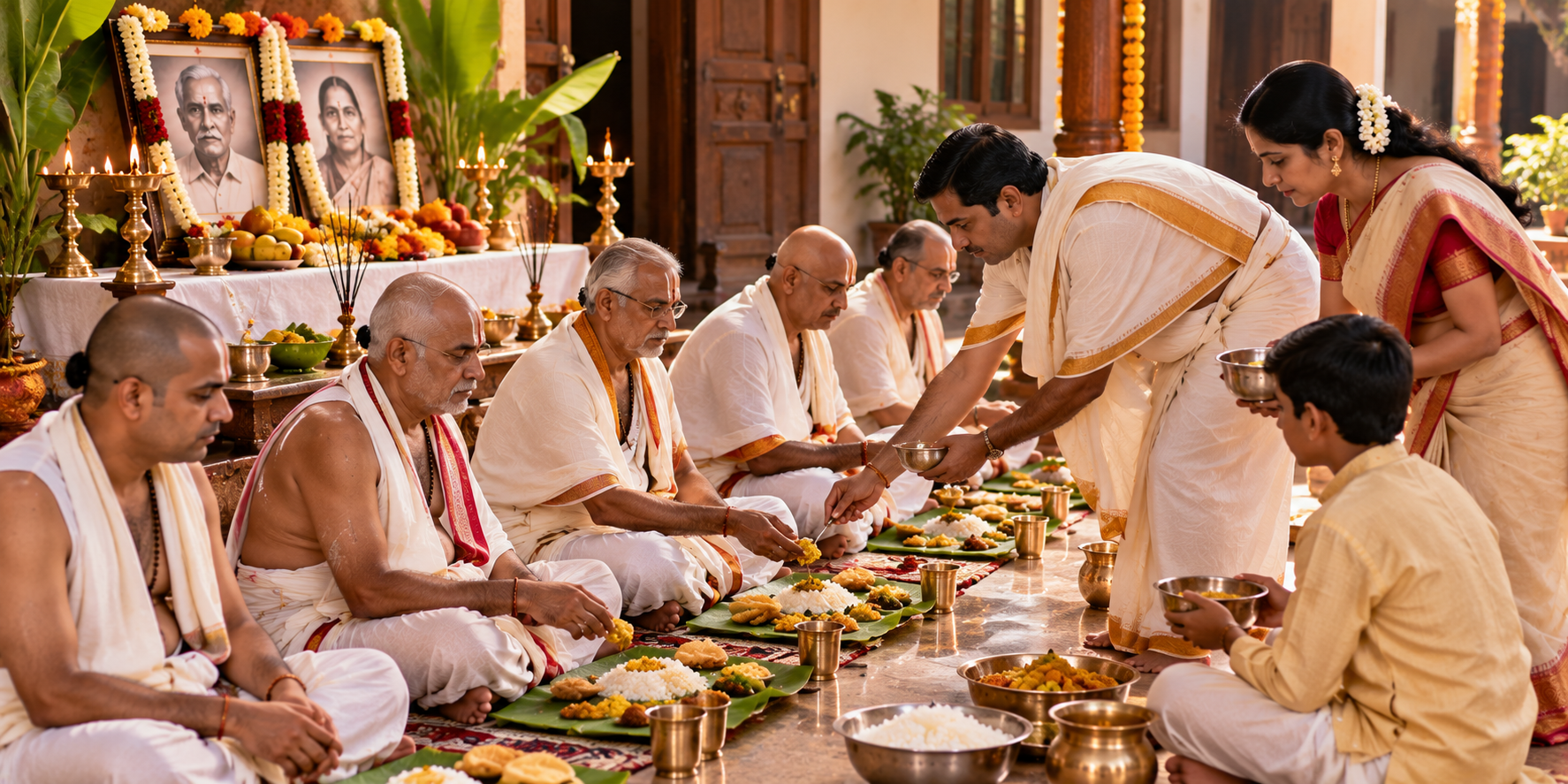
Being invited to a Shraddha, as a relative, friend or the honoured guest who represents the ancestors, is a mark of trust.
- Arrive on time and quietly. Rituals often begin at a set time in the late morning.
- Dress simply in clean, subdued clothes. See what to wear.
- Do not bring flowers, sweets or gifts meant for celebrations unless the host asks. A donation in the ancestors' name is a thoughtful alternative.
- Follow the host's lead on seating, removing shoes and where to stand.
- Photographs: ask before taking any.
- Eating: if you are served as a guest who represents the ancestors, eat calmly and without criticism; it is customary to accept the food offered. Mention dietary needs discreetly in advance.
- Conversation: gentle, respectful and about the person remembered. Avoid jokes and arguments.
- Leaving: thank the host; there is no need for festive farewells.
19 of 20
100 Shraddha and Pitru Paksha Questions and Answers
One hundred short answers, grouped by theme. Each links to the guide that covers it in depth where useful.
Basics
| Question | Short answer |
|---|---|
| 1. What is Pitru Paksha? | A lunar fortnight dedicated to honouring ancestors with Shraddha, tarpan and charity. |
| 2. What does Pitru mean? | Ancestors, literally "fathers"; in ritual use, departed forebears of the family. |
| 3. What is Shraddha? | A rite for ancestors performed with faith (shraddha). |
| 4. Is Shraddha the same as Pitru Paksha? | No. Shraddha is the rite; Pitru Paksha is the period when it is especially performed. |
| 5. Why is it observed? | To express gratitude, fulfil duty to ancestors and keep the lineage's memory alive. |
| 6. How long is it? | About 15 or 16 days, from Purnima or Pratipada to Amavasya. |
| 7. Is it a festival? | It is an observance of remembrance, not a celebration. |
| 8. Who observes it? | Hindu families across India, Nepal and the diaspora; customs vary widely. |
| 9. Is it compulsory? | Tradition treats it as a duty, but families observe it in many different degrees. |
| 10. Where should a beginner start? | With what happens during Pitru Paksha. |
Dates and timing
| Question | Short answer |
|---|---|
| 11. When is Pitru Paksha 2026? | 15 to 10 October 2026 in the New Delhi reference. |
| 12. When is Sarva Pitru Amavasya 2026? | Wednesday 10 October 2026 in the New Delhi reference. |
| 13. When was it in 2026? | 26 September to 10 October 2026 in India. |
| 14. Why do dates change every year? | They follow the lunar calendar, not the Gregorian one. |
| 15. Which lunar month is it in? | Bhadrapada (purnimanta) or Ashwin (amanta) Krishna Paksha, the same days by different naming. |
| 16. Are dates the same abroad? | Often, but a tithi can fall a day earlier or later; use a local Panchang. |
| 17. What time of day is Shraddha done? | Traditionally the midday to afternoon period (kutapa and aparahna). |
| 18. Can a tithi be skipped in the calendar? | Yes. In the New Delhi 2026 reference, Chaturthi and Panchami are both assigned to 30 September because both tithis intersect the relevant afternoon decision window. |
| 19. What comes after Pitru Paksha? | Navratri follows Pitru Paksha; check the local 2026 festival calendar for its exact date. |
| 20. Where is the full calendar? | See the 2026 day-by-day calendar. |
Tithis
| Question | Short answer |
|---|---|
| 21. What is a tithi? | A lunar day, one thirtieth of the lunar month. |
| 22. How is an ancestor's tithi chosen? | It is the lunar tithi on which the ancestor died. |
| 23. Does paksha matter? | No; in Pitru Paksha the tithi number is used whichever fortnight the death fell in. |
| 24. What is Matru Navami? | The Navami Shraddha for mothers and married women who died before their husbands, in many traditions. |
| 25. What is Chaturdashi Shraddha for? | In many traditions, for those who died untimely or sudden deaths. |
| 26. What is Indira Ekadashi? | The Ekadashi of Pitru Paksha, observed with fasting by many families. |
| 27. What is Bharani Shraddha? | A Shraddha on the day of Bharani nakshatra during the fortnight, observed in some traditions. |
| 28. What if the tithi is unknown? | Perform Shraddha on Sarva Pitru Amavasya. |
| 29. Is Purnima Shraddha part of Pitru Paksha? | Many calendars include it as the opening day. |
| 30. Where are all tithis explained? | See Shraddha by tithi. |
Rituals
| Question | Short answer |
|---|---|
| 31. What is tarpan? | Offering water mixed with sesame to ancestors. |
| 32. What is pind daan? | Offering balls of rice or flour with sesame to ancestors. |
| 33. What is sankalpa? | The statement of intention at the start of a ritual. |
| 34. Why face south? | South is traditionally associated with the ancestors and Yama. |
| 35. Why is sesame used? | It is traditionally linked to ancestral offerings and considered purifying. |
| 36. Why is kusha grass used? | It is considered sacred and purifying and is worn as a ring (pavitri). |
| 37. What is Brahmin bhoj? | Feeding learned Brahmins as representatives of the ancestors. |
| 38. Can Shraddha be done at home? | Yes; the home is a standard setting for Shraddha. |
| 39. What samagri is needed? | Sesame, kusha, water vessel, rice, ghee, flowers and more. See samagri list. |
| 40. How long does a home Shraddha take? | Roughly one to two hours with a priest; a simple tarpan takes minutes. |
Food
| Question | Short answer |
|---|---|
| 41. What food is cooked? | Satvik vegetarian food, commonly kheer, puri, seasonal vegetables and dal. |
| 42. Why kheer? | Milk and rice are widely considered pure and pleasing offerings. |
| 43. Are onion and garlic avoided? | By many families, as they are not considered satvik. |
| 44. Why feed crows? | Crows are traditionally seen as messengers linked to ancestors. |
| 45. Why feed cows? | Cows are revered, and feeding them is a traditional act of merit. |
| 46. Can the family eat the food? | Yes, after the offerings and guests have been served. |
| 47. Can restaurant food be used? | Families differ; many prefer home-cooked food for the offering. |
| 48. What if no crow comes? | Many families leave the portion and proceed, or give it to another creature or person. |
| 49. Are non-vegetarian foods allowed? | Most families avoid them, though some communities have other customs. |
| 50. Where are recipes? | See Shraddha food traditions. |
Pilgrimage
| Question | Short answer |
|---|---|
| 51. Why is Gaya important? | It is praised in tradition as the foremost place for pind daan. |
| 52. What is Vishnupad? | The temple at Gaya enshrining Vishnu's footprint, central to pind daan there. |
| 53. What is the Phalgu? | The river at Gaya on whose banks pind daan is offered. |
| 54. What is Akshayavat? | The sacred banyan at Gaya, often the final site of the Gaya pind daan. |
| 55. Why Haridwar? | For tarpan at the Ganga, especially at Har Ki Pauri, and family registers kept by pandas. |
| 56. What is Brahma Kapal? | A site at Badrinath associated with ancestral rites. |
| 57. Is pilgrimage required? | No. Home observance is complete in itself. |
| 58. Who is a panda? | A hereditary pilgrimage priest who guides rites and often keeps family records. |
| 59. When is Gaya busiest? | During Pitru Paksha, when the Pitru Paksha Mela is held. |
| 60. How to plan a trip? | See planning a pind daan pilgrimage. |
Family and who performs
| Question | Short answer |
|---|---|
| 61. Who traditionally performs Shraddha? | The eldest son, or another eligible relative. |
| 62. Can a younger son perform it? | Yes; practice varies on whether all sons or one son performs. |
| 63. Can women perform Shraddha? | Traditions differ; many families and priests accept it today. |
| 64. Can daughters perform it? | Many priests accept daughters, especially where there is no son. |
| 65. Can a son-in-law perform it? | In some traditions, where no closer relative is available. |
| 66. Can one person perform for many ancestors? | Yes; each is named in the sankalpa. |
| 67. Are maternal ancestors included? | Yes, in many forms of Shraddha. |
| 68. Is Shraddha done for friends or teachers? | Mahalaya Shraddha is often described as including teachers, friends and others. |
| 69. What about a recent death? | First-year rites apply; ask a priest. |
| 70. Where is more on family roles? | See who can perform Shraddha. |
Abroad and modern life
| Question | Short answer |
|---|---|
| 71. Can Shraddha be done abroad? | Yes, at home or at a temple. |
| 72. Which date should families abroad use? | The local Panchang date. |
| 73. Can a priest guide by video? | Yes; widely accepted when a family member performs. |
| 74. What if there is no priest? | Families can perform tarpan and a simple Shraddha themselves. |
| 75. What if gotra is unknown? | Many priests use Kashyapa gotra. |
| 76. Where to pour tarpan water abroad? | Onto a plant or garden soil. |
| 77. Can the meal move to a weekend? | Many families do this while keeping tarpan on the tithi. |
| 78. Can apartments work? | Yes, with a small space, a plate and a plant. |
| 79. How to explain it to children? | Start with stories and photos of real ancestors. |
| 80. Where is the diaspora guide? | See Pitru Paksha abroad. |
Customs and restrictions
| Question | Short answer |
|---|---|
| 81. Can weddings be held? | Traditionally no; they are postponed. |
| 82. Can you buy a car or house? | Many families avoid major purchases. |
| 83. Can you wear new clothes? | Traditionally avoided. |
| 84. Can you cut hair? | Many men, especially performers, avoid it. |
| 85. Can you travel? | Yes; ordinary life continues. |
| 86. Can you go to work? | Yes. |
| 87. Can you visit temples? | Yes; many visit temples for ancestral rites. |
| 88. Can you celebrate birthdays? | Many families keep them low-key. |
| 89. What colours to wear? | White and muted colours are common. |
| 90. What should guests do? | Dress simply, follow the host and eat calmly. |
Scripture and symbolism
| Question | Short answer |
|---|---|
| 91. Where does Shraddha appear in scripture? | In Vedic texts, the Grihya Sutras, Dharmashastras and Puranas. |
| 92. What does the Garuda Purana say? | It is widely associated with rites for the dead, though popular retellings vary. |
| 93. What is the Karna story? | A popular retelling that links Karna's return to earth with Pitru Paksha; it is not in the critical edition of the Mahabharata. |
| 94. What is Pitru Loka? | The traditional realm of the ancestors. |
| 95. What is Pitru Rina? | The debt or responsibility owed to ancestors. |
| 96. What are the three debts? | To the gods, sages and ancestors, as in the Taittiriya Samhita. |
| 97. What does water symbolise? | Life, continuity and the offering that reaches ancestors. |
| 98. What does the pinda symbolise? | Nourishment and the bond of lineage. |
| 99. Is Shraddha mainly ritual or remembrance? | Both, in different proportions for different families. |
| 100. Where is more on scripture? | See Shraddha in Hindu textual traditions. |
20 of 20
Shraddha and Pitru Paksha Glossary: 50 Ritual Terms and Concepts Explained
Fifty terms you are likely to hear from priests, elders and Panchangs, in alphabetical order. Spellings vary between languages and regions.
| Term | Meaning |
|---|---|
| Akshayavat | The sacred banyan tree at Gaya, a key site of pind daan. |
| Amavasya | The new moon day; the final day of Pitru Paksha. |
| Aparahna | The afternoon portion of the day, traditionally suited to Shraddha. |
| Apasavya | Wearing the sacred thread over the right shoulder for ancestral rites; also called prachinaviti. |
| Ashwin | The lunar month in whose dark fortnight Pitru Paksha falls in the amanta calendar. |
| Bhadrapada | The lunar month in whose dark fortnight Pitru Paksha falls in the purnimanta calendar. |
| Brahmin bhoj | Feeding learned Brahmins as representatives of the ancestors. |
| Dakshina | The offering given to a priest for performing a rite. |
| Daan | Charity or a ritual gift. |
| Darbha | Another name for kusha grass. |
| Dauhitra | A daughter's son, who has a special role in his maternal grandfather's Shraddha. |
| Ekoddishta | A Shraddha directed to a single deceased person, especially before sapindikarana. |
| Gaya | The city in Bihar most celebrated for pind daan. |
| Gotra | The patrilineal clan lineage traced to a rishi, named in the sankalpa. |
| Hiranya shraddha | A Shraddha in which uncooked provisions and dakshina are given instead of a cooked meal. |
| Kak bali | The portion of food offered to crows. |
| Kanagat | A North Indian name for Pitru Paksha. |
| Karta | The person who performs the rite. |
| Kashyapa gotra | The gotra commonly used when the family gotra is unknown. |
| Krishna Paksha | The waning, dark fortnight of the lunar month. |
| Kusha | A sacred grass used in rituals and worn as a ring. |
| Kutapa | The eighth muhurta of the day, around midday, especially recommended for Shraddha. |
| Mahalaya | The ancestral fortnight or its final day, depending on region. |
| Mahalaya Amavasya | The new moon ending Pitru Paksha; the same as Sarva Pitru Amavasya. |
| Matamaha | Maternal grandfather. |
| Matru Navami | The Navami of Pitru Paksha, dedicated in many traditions to mothers and married women. |
| Muhurta | A traditional unit of time of about 48 minutes; also an auspicious time. |
| Panchang | The Hindu almanac of tithis, nakshatras and other calendar elements. |
| Panda | A hereditary pilgrimage priest at a tirtha. |
| Parvana shraddha | A Shraddha for three generations of ancestors together. |
| Pavitri | A ring of kusha worn on the finger during rites. |
| Phalgu | The river at Gaya associated with pind daan. |
| Pinda | A ball of cooked rice or flour offered to ancestors. |
| Pind daan | The offering of pindas. |
| Pitru | Ancestor. |
| Pitru Loka | The realm of the ancestors. |
| Pitru Paksha | The fortnight of the ancestors. |
| Pitru Rina | The debt or responsibility owed to ancestors. |
| Preta | The newly departed soul before joining the ancestors. |
| Purohit | A family or ritual priest. |
| Samagri | The materials needed for a ritual. |
| Sankalpa | A formal statement of intention before a rite. |
| Sapindikarana | The rite that unites the recently deceased with the ancestors. |
| Sarva Pitru Amavasya | The "all ancestors" new moon at the end of Pitru Paksha. |
| Satvik | Pure, simple food and conduct, typically vegetarian and without onion or garlic. |
| Shraddha | A rite for ancestors performed with faith. |
| Tarpan | Offering water, often with sesame, to ancestors. |
| Til | Sesame seeds, especially black sesame, used in ancestral rites. |
| Tithi | A lunar day. |
| Vishnupad | The temple at Gaya enshrining Vishnu's footprint. |
Frequently asked questions
What is the difference between Shraddha and tarpan?
Shraddha is the complete ancestral rite; tarpan is the offering of water with sesame, usually part of Shraddha but also performed on its own.
Are Mahalaya Amavasya and Sarva Pitru Amavasya the same?
Yes. Both names refer to the new moon that ends Pitru Paksha, which falls on 10 October 2026 in the New Delhi reference.
What should I do if I missed my ancestor's Shraddha tithi?
Perform Shraddha or tarpan on Sarva Pitru Amavasya, which is traditionally meant for all ancestors, including those whose tithi was missed or is unknown.
Can weddings be held during Pitru Paksha?
Traditionally no. Weddings, engagements, housewarmings and other auspicious ceremonies are commonly postponed until after Pitru Paksha.
Can Shraddha be performed for someone who died recently?
First-year rites such as sapindikarana follow their own schedule, and communities differ on whether a separate Pitru Paksha Shraddha is performed in the first year. Ask your family priest.
What should a guest wear to a Shraddha?
Clean, simple clothes in white or muted colours, without festive jewellery or bright prints.