
Contents: 20 topics
- How to Observe Pitru Paksha in the United States
- How to Perform Simple Tarpan in the United States
- Pitru Paksha in Canada: Home Observance and Timing Considerations
- Pitru Paksha in the United Kingdom: Home Observance Guide
- Pitru Paksha in Australia: Practical Family Guide
- Pitru Paksha in Dubai and the UAE: Practical Observance Guide
- How to Find a Hindu Priest for Shraddha Outside India
- How to Find a Temple Offering Pitru Paksha Services Near You
- Can Shraddha Be Performed Online or with Remote Priest Guidance?
- How to Perform Shraddha When Family Members Live in Different Countries
- How to Observe Shraddha When You Cannot Visit a River or Sacred Place
- Can Women Perform Shraddha or Tarpan? Understanding Different Traditions
- Can Daughters Perform Shraddha? Family, Regional and Contemporary Practices
- Can a Family Perform Shraddha Without a Priest?
- How to Handle Shraddha When the Family Gotra Is Unknown
- How to Observe Pitru Paksha in a Small Apartment
- How to Balance Work Schedules with Shraddha Observance
- Pitru Paksha for Interfaith and Multicultural Families
- How to Explain Shraddha Traditions to Children Raised Abroad
- Modern Shraddha FAQ: Diaspora, Family Roles, Remote Rituals and Practical Constraints
- Frequently asked questions
For many families, Pitru Paksha now happens far from the river ghats, family priests and joint households that once carried it. It happens in a townhouse in New Jersey, a flat in Leicester, a high-rise in Dubai Marina or a suburb of Melbourne, often on a work night, sometimes with relatives joining by video from three time zones.
This guide is for those families. It covers country-by-country practicalities, how to find a priest or temple, whether remote and online rituals are accepted, how to coordinate a scattered family, and the questions modern households raise most often: whether women and daughters can perform Shraddha, what to do without a priest or a known gotra, and how to explain it all to children raised abroad.
Key takeaways
- Check tithis in a Panchang set to your own city; abroad, a Shraddha date can fall a day earlier than in India.
- Temples in most large diaspora cities offer tarpan, Shraddha or Mahalaya services; many priests also guide rituals by video.
- When family is scattered, a main performer plus remote participation is a widely accepted pattern.
- Traditions differ on women and daughters; many families and priests now accept them as performers, especially where no son is available.
- An unknown gotra is commonly handled with Kashyapa gotra, and a small apartment can hold a complete, respectful observance.
1 of 20
How to Observe Pitru Paksha in the United States
The United States has one of the largest Hindu communities outside South Asia, with temples in most major metropolitan areas. Pitru Paksha observance there usually takes one of three forms.
- At home, family-led: daily or tithi-day tarpan, a simple satvik meal offered to ancestors, feeding the needy or donating to a food bank, and a collective observance on Sarva Pitru Amavasya.
- At home, priest-guided: a temple priest visits, or guides the family by video, for the main Shraddha on the ancestor's tithi.
- At a temple: many temples hold a collective Mahalaya tarpan, usually on the weekend nearest Mahalaya Amavasya or on the day itself, and some offer individual Shraddha by appointment.
Timing in the US
For 2026, the New Delhi reference uses Purnima Shraddha on 26 September, Pratipada on 27 September and Sarva Pitru Amavasya on 10 October. In the cited New York/New Jersey example, those reference dates are 25 September, 26 September and 9 October. Set your Panchang app or website to your own city, not to Delhi. See US timing considerations.
Practical notes
- Book priests early. Demand peaks on Mahalaya weekends, and a single priest may cover several homes a day.
- Keep sesame, kusha (or a substitute your priest accepts), a copper or steel vessel and a plate ready before the fortnight begins; Indian grocery stores usually stock them.
- Many families shift the meal and gathering to the nearest weekend while keeping tarpan on the tithi itself. See balancing work schedules.
2 of 20
How to Perform Simple Tarpan in the United States
A simple tarpan can be done in any home with a bowl, water and sesame. The outline below is general; your priest or family may add mantras, names or steps.
- Prepare in the morning after bathing, facing south if the space allows. Place a plate or wide bowl to receive the water.
- Gather: clean water, black sesame (til), a little kusha grass or a kusha ring if available, and a vessel to pour from.
- Sankalpa: state, silently or aloud, who you are, the date, and that you are offering tarpan to your ancestors. Name them if you know their names.
- Offer water: mix sesame into the water and pour it three times for each ancestor named (traditionally over the right-hand side of the palm, between thumb and forefinger, for ancestors), then once for all ancestors known and unknown.
- Close with a short prayer, a moment of silence, or a request for blessings.
What to do with the water
In the US, pouring offerings directly into rivers, lakes or the ocean may be restricted by local rules, and many families prefer not to leave sesame or other materials in waterways. Common, respectful alternatives:
- Pour the water onto the soil of a tree or garden plant.
- Pour it at the base of a potted plant (not one grown for food, if your family observes that distinction).
- Where a temple has a designated area for offerings, use that.
For the fuller home method, see how water tarpan is offered and simple tarpan when a full Shraddha is not possible.
3 of 20
Pitru Paksha in Canada: Home Observance and Timing Considerations
Canadian Hindu communities are concentrated in the Greater Toronto Area, Greater Vancouver, Montreal, Calgary, Edmonton and Ottawa, and temples in these regions commonly hold Mahalaya observances.
Timing
Canada spans multiple time zones, so each household should use a Panchang set to its own city. In the cited Toronto 2026 example, Purnima Shraddha is 25 September, the Pratipada sequence begins 26 September, and Sarva Pitru Amavasya is 9 October. See Canada timing.
Home observance
- Late September is usually cool and often wet. Offer tarpan indoors into a plate, then pour the water onto garden soil or a potted plant.
- Crows are common in Canadian cities; some families place a small portion of the meal outdoors for birds where local by-laws allow, while others give food to a shelter instead. See feeding animals and the needy.
- Families with Gujarati, Punjabi, Tamil and Bengali roots may follow quite different customs; ask elders or your community's priest rather than relying on a single template.
4 of 20
Pitru Paksha in the United Kingdom: Home Observance Guide
The UK's Hindu population is concentrated in London, Leicester, Birmingham, Manchester and other cities, with Gujarati, Punjabi, Tamil, Bengali and East African Indian roots all well represented. Customs vary accordingly.
Timing
For the cited UK 2026 example, Purnima Shraddha is 26 September, the Pratipada sequence begins 27 September, and Sarva Pitru Amavasya is 10 October. Local clock times still differ, so use a Panchang calculated for your UK city. See UK timing.
Home observance
- Many UK families perform tarpan at home and attend a temple observance on or near Mahalaya Amavasya.
- Some temples arrange priests for home Shraddha or hold group tarpan; bookings fill quickly on weekends.
- For immersion of ashes or offerings, some UK local authorities and communities have designated riverside sites for Hindu and Sikh rites. For ordinary tarpan water, pouring onto garden soil or a plant is the simple, widely used option.
- Autumn weather makes outdoor offerings unreliable; plan to do everything indoors.

5 of 20
Pitru Paksha in Australia: Practical Family Guide
In Australia, Pitru Paksha falls in early spring. Hindu communities are largest in Sydney, Melbourne, Brisbane, Perth and Adelaide, and many temples there observe Mahalaya.
Timing
Australia is ahead of India and spans several time zones. In the cited Sydney 2026 example, Purnima Shraddha is 26 September, the Pratipada sequence begins 27 September, and Sarva Pitru Amavasya is 10 October. Some intermediate tithi assignments can still differ, so use the local city calendar. See Australia timing.
Practical notes
- Spring weather allows outdoor tarpan in a backyard or balcony for many families. Pour water onto soil, not into stormwater drains.
- Birds such as ravens, magpies and mynas often take the crow's role in family practice; some families simply feed any bird that comes. Check local rules about feeding wildlife.
- Where a family cannot feed animals, donating food or money to a food relief charity is a widely accepted substitute.
6 of 20
Pitru Paksha in Dubai and the UAE: Practical Observance Guide
The UAE has a very large Indian population, and many families observe Pitru Paksha at home, often in apartments, with a small number of temples serving the community.
Where to look for services
- The long-established Hindu temple complex in Jebel Ali (Dubai) and the BAPS Hindu Mandir in Abu Dhabi are the obvious places to ask; services and schedules change, so confirm directly.
- Community associations organised by region or language (Tamil, Malayali, Gujarati, Bengali and others) often know which priests perform home Shraddha.
- Many families use a priest in India guiding them by video. See remote priest guidance.
Timing
In the cited Dubai 2026 example, Purnima Shraddha is 26 September, the Pratipada sequence begins 27 September, and Sarva Pitru Amavasya is 10 October. Muhurat windows use Gulf Standard Time, so check a Panchang set to Dubai or Abu Dhabi. See UAE calendar guide.
Practical notes
- September is still hot. Prepare food early, keep it covered, and follow food safety guidance.
- Many buildings do not allow leaving food outdoors. Donate food or give to a charity instead of feeding birds on balconies.
- For the New Delhi 2026 reference, weekend dates inside the overall period include 26–27 September, 3–4 October and 10 October; local civil dates abroad can differ.
7 of 20
How to Find a Hindu Priest for Shraddha Outside India
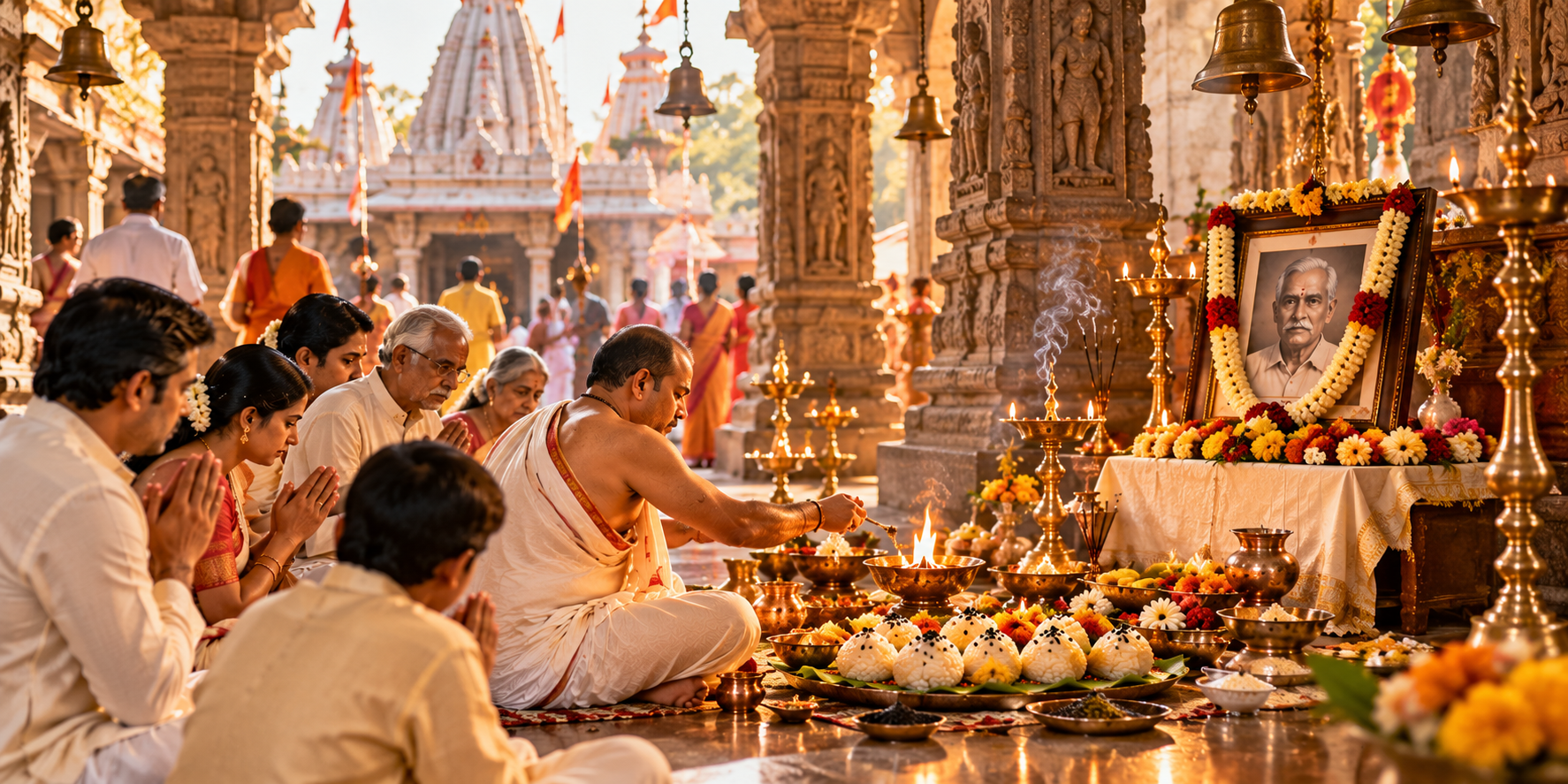
Finding a priest (purohit or pandit) who performs ancestral rites is the most common practical question abroad. Useful routes:
- Your nearest large temple. Most employ resident priests and publish a list of services, often including Shraddha, tarpan, Mahalaya and death anniversary rites.
- Regional and language associations. A Telugu, Marathi, Bengali or Gujarati association usually knows which priests follow that community's procedure.
- Word of mouth. Ask families who recently held a funeral or death anniversary; ancestral rites are a specialised service and good priests are known locally.
- Your family priest in India. Many will guide the ritual by video, or perform it in India on your behalf while you participate.
What to ask
- Which tradition or procedure they follow (for example, a particular Veda shakha or regional practice), and whether that matches your family's.
- Whether they come to your home, perform at the temple, or guide remotely.
- What they will bring and what you must arrange: samagri, food, and whether a meal for the priest is expected.
- Their dakshina (offering) and any temple fees, confirmed in advance.
For pilgrimage-site priests and pandas, see choosing a priest at a pilgrimage site.
8 of 20
How to Find a Temple Offering Pitru Paksha Services Near You
Temples vary widely in what they offer during Pitru Paksha. Some hold a single collective Mahalaya tarpan; some offer individual Shraddha on each tithi; some offer none but will refer you to a priest.
How to search
- Look at temple websites and social media pages in late August and early September, when Pitru Paksha schedules are usually announced.
- Search for the terms temples actually use: Mahalaya, Mahalaya Amavasya, tarpanam, Shraddha, pitru tarpan, Pitru Paksha puja.
- Call the temple office. Many services are booked by phone and never listed online.
- Ask whether the temple offers sponsorship of a collective rite, which lets relatives abroad include their ancestors' names.
What to expect at a collective observance
A priest leads a group through sankalpa and tarpan; each family names its ancestors; water with sesame is offered; food and dakshina are given. Bring a list of names (and gotra if known), arrive early, and dress simply. See how a guest should behave and what to wear.
9 of 20
Can Shraddha Be Performed Online or with Remote Priest Guidance?
Remote Shraddha has become common, especially since 2020, and there are two different arrangements under that name.
| Arrangement | What happens | How it is viewed |
|---|---|---|
| Priest guides, family performs | The priest recites and instructs by video; a family member performs the actions at home. | Widely accepted, because the family member is still the performer (karta). |
| Priest performs on the family's behalf | The rite is done at a temple or pilgrimage site, sometimes streamed; the family gives names, gotra and dakshina. | Accepted by many as a proxy rite; some traditions prefer the karta to be physically present. |
| Watching only | The family views a collective rite with no participation. | Seen by most as a form of remembrance rather than a full Shraddha. |
Choosing a service
- Prefer temples and priests you can verify over anonymous websites.
- Be wary of fear-based marketing about ancestral curses or urgent "doshas". Traditional Shraddha is framed around gratitude and duty, not threat.
- Ask what exactly will be done, where, by whom, and whether you will see it.
10 of 20
How to Perform Shraddha When Family Members Live in Different Countries
A family with siblings in Hyderabad, Houston and Hamburg cannot gather for every Shraddha. Common, workable patterns:
- One main performer, everyone participating. The person traditionally responsible (or the one best placed that year) performs the Shraddha; others join by video for the sankalpa and prayers, and perform a simple tarpan in their own homes.
- Each household performs independently. Siblings each do tarpan or Shraddha on the tithi in their own city, using their local Panchang.
- Rotating host. The main Shraddha rotates between households year to year.
- Sponsored rite in India. One sibling arranges a priest-led Shraddha at the family home, temple or a pilgrimage site, and others contribute and attend remotely.
Coordination tips
- Agree in advance who is the karta for each ancestor, so there is no confusion or offence.
- Share a single written list of ancestors' names, relationships, tithis and gotra. See writing a family ancestor record.
- Remember that time zones can put the tithi on different dates in different countries; each household should use its own local Panchang.
- Record elders' blessings or stories on the call. See remembering ancestors from far away.
11 of 20
How to Observe Shraddha When You Cannot Visit a River or Sacred Place
Rivers and tirthas carry great weight in tradition, but the household has always been the primary setting for Shraddha. Tarpan and pinda offerings at home are part of standard practice, not a lesser substitute.
Ways families bring the sacred place home
- Add a few drops of Ganga jal (commonly sold in sealed bottles) to the tarpan water, if your family uses it.
- Recite or listen to the names of sacred rivers and tirthas as part of the sankalpa, as many priests do.
- Plan a future pilgrimage to Gaya, Haridwar or another site as a separate family intention. See planning a pind daan pilgrimage.
- Where a local river or beach is used by the community, follow any local rules and avoid leaving materials in the water.
For the difference between home and riverbank tarpan, see tarpan at home vs riverbank.
12 of 20
Can Women Perform Shraddha or Tarpan? Understanding Different Traditions
This is one of the most discussed questions in modern families, and honest answers vary by tradition.
The traditional pattern
Classical Dharmashastra texts generally assign Shraddha to a son, and in his absence set out an order of other eligible relatives. Several traditional authorities and commentators include the wife and daughter in that order when no son is available. Actual practice has varied by region and community.
Common positions today
- Some families and priests hold that only male relatives should perform the main Shraddha, while women prepare food, make offerings of remembrance and participate in prayers.
- Many families and priests accept a woman as karta where there is no son or male relative able to perform, or where she is the closest surviving relative.
- A growing number accept women performing Shraddha and tarpan as a matter of course.
- In some communities women traditionally perform particular rites, and news reports from India and Nepal have highlighted daughters and widows performing last rites and annual ceremonies.
Practical guidance
Discuss it within the family and with your priest. If one priest declines, another from a different tradition may not. Whatever the family decides, women's roles in preparing the meal, keeping memory and passing on custom are central to how Shraddha has actually been sustained.
13 of 20
Can Daughters Perform Shraddha? Family, Regional and Contemporary Practices
Families with only daughters, or where daughters are the ones living nearby, increasingly ask whether a daughter can perform her parent's Shraddha.
- Traditional allowance: Many priests point out that traditional rules on eligible performers include a daughter (and a daughter's son) when no son is available.
- Regional and community variation: Acceptance is broader in some communities and regions than others, and individual priests differ within the same city.
- Contemporary practice: Daughters performing last rites and annual Shraddha has become more visible in urban India and in the diaspora, and many priests now guide daughters without hesitation.
- Shared roles: Some families have a daughter and a male relative perform together, or have the daughter perform tarpan while another relative performs pind daan.
14 of 20
Can a Family Perform Shraddha Without a Priest?
Yes, in many forms. Tarpan, a simple food offering, feeding others and charity are routinely done by families without a priest. A full Shraddha with homa, pinda offerings and Vedic mantras is traditionally priest-led, but many families perform a simplified version themselves.
A simple family-led observance
- Clean the space and set up a small remembrance area with photographs.
- Perform a simple tarpan with water and sesame, naming each ancestor.
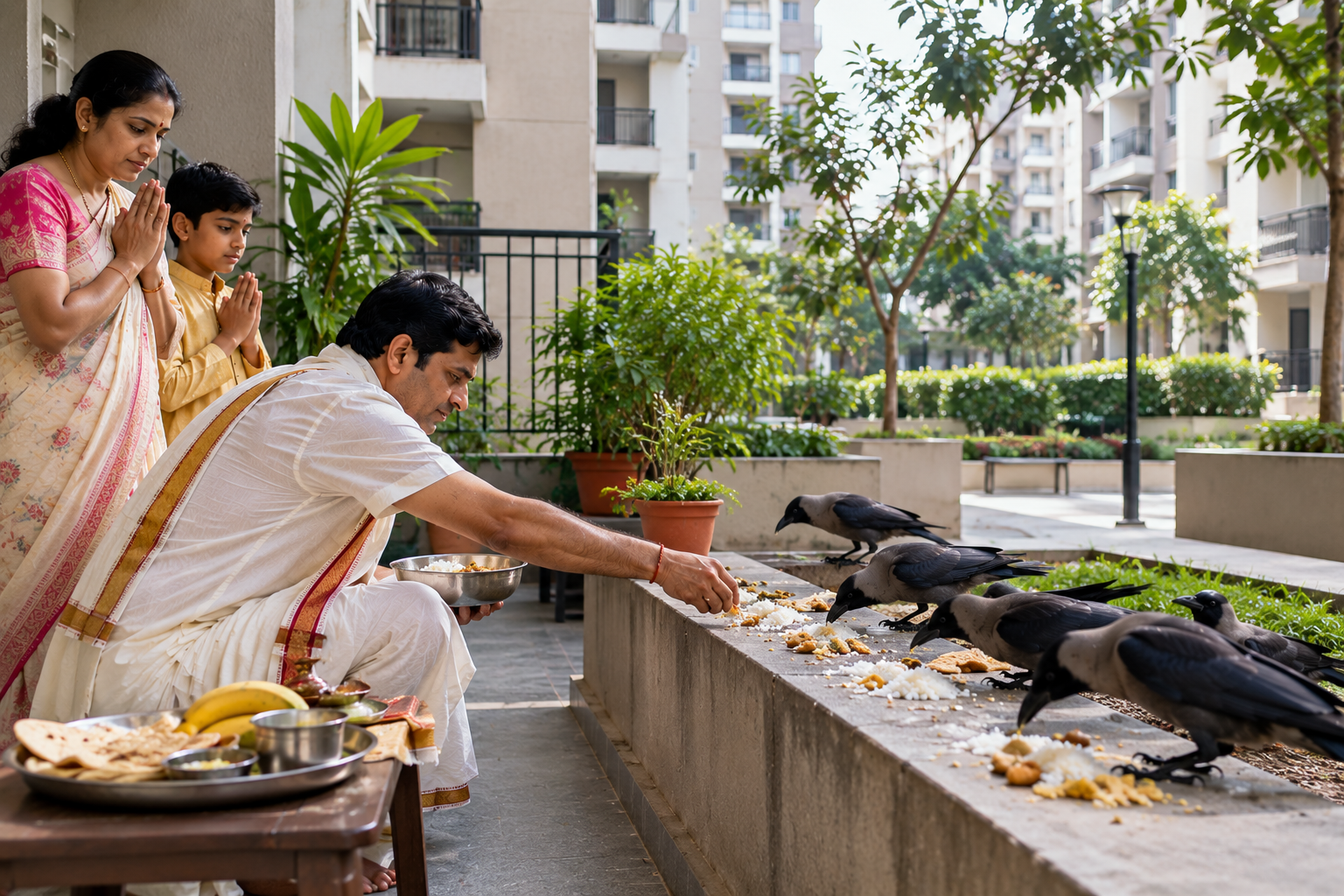
- Offer a satvik meal on a separate plate for the ancestors, keeping a portion aside for crows, cows or animals, or for charity.
- Feed a guest, a needy person, or donate food.
- Close with prayers and time to share memories.
When a priest helps most
- The first annual Shraddha after a death, where specific rites apply. See Shraddha after a recent death.
- Pind daan, especially at pilgrimage sites.
- When the family wants the full traditional procedure with mantras.
15 of 20
How to Handle Shraddha When the Family Gotra Is Unknown
Families lose track of gotra through migration, adoption, conversion or simply because no one wrote it down. It does not prevent observance.
- Kashyapa gotra: A widely followed convention is to use Kashyapa gotra when the family gotra is unknown, on the understanding that all beings descend from the sage Kashyapa. Many priests do this routinely.
- Ask relatives and records: Older relatives, wedding invitations, horoscopes, temple or pilgrimage records (Gaya and Haridwar pandas have historically kept family registers) may hold the answer.
- Name without gotra: Some priests simply use the ancestors' names and relationships.
A married woman's gotra is treated differently across traditions; ask your priest how your family's custom handles it.
See Shraddha without knowing gotra and unknown tithi or gotra.
16 of 20
How to Observe Pitru Paksha in a Small Apartment
A studio or one-bedroom flat can hold a complete, respectful observance.
- Space: a small table, shelf or cleaned corner with a cloth, photographs, a lamp and a plate. See making an ancestor memory corner.
- Direction: face south during tarpan if the room allows; if not, most priests say sincerity matters more than orientation.
- Water: offer into a plate or bowl, then pour onto a potted plant.
- Lamp: use a ghee or oil lamp only if it is safe under your building's rules; a battery lamp is an accepted alternative for many families. Never leave a flame unattended and keep it away from smoke detectors and curtains.
- Crows and cows: if you cannot feed them, keep aside the portion anyway and give it, or its equivalent, to a food bank or someone in need.
- Smell and neighbours: satvik food without onion and garlic is mild, and incense can be skipped or kept brief.
See also observing Pitru Paksha in an apartment.
17 of 20
How to Balance Work Schedules with Shraddha Observance
Most people abroad work through Pitru Paksha. Families commonly separate what must happen on the tithi from what can move.
| Element | Typical flexibility |
|---|---|
| Tarpan on the tithi | Often done early in the morning before work; takes 10 to 20 minutes. |
| Main Shraddha with priest | Many families keep it on the tithi; some move it to the nearest weekend or to Sarva Pitru Amavasya. |
| Family meal and gathering | Frequently moved to a weekend. |
| Charity and feeding others | Can be done any day in the fortnight, or online. |
2026 calendar points
Pitru Paksha 2026 begins on Wednesday 15 September and ends on Wednesday 29 September (Sarva Pitru Amavasya). The weekends inside the fortnight are 18–19 and 25–26 September. Check your own city's Panchang for exact tithi dates.
At work
- Many employers allow religious observance leave or flexible hours; ask early.
- A short explanation is usually enough: "It is an annual remembrance of my family's ancestors, and I have a morning ritual that day."
- If you observe dietary restrictions, you may want to plan meals for office days.
18 of 20
Pitru Paksha for Interfaith and Multicultural Families
Couples and families that combine Hindu and other traditions often find Pitru Paksha one of the easier observances to share, because honouring the dead is common ground across cultures.
- Parallels: Many traditions have ancestral days: Qingming in China, Chuseok in Korea, Obon in Japan, All Souls' Day and Día de los Muertos in Christian and Latin American cultures. Pointing to them helps partners and children understand.
- Roles: A non-Hindu spouse may prepare food, keep photographs, join the prayers or simply sit with the family. Whether they perform ritual acts is a matter for the family and priest.
- Both sides: Some families use the fortnight to remember ancestors from both sides, with the Hindu rite for one lineage and a simple remembrance for the other.
- Food: Satvik dishes are vegetarian and usually welcomed by everyone at the table.
19 of 20
How to Explain Shraddha Traditions to Children Raised Abroad
Children raised outside India often meet Pitru Paksha without the surrounding culture that makes it feel normal. A few approaches that families find helpful:
- Start with people, not rules. Show photographs, tell stories, name the great-grandparents. Children engage with a person before a ritual. See teaching children about ancestors.
- Explain symbols simply. Water is a gift, sesame is a traditional offering, feeding birds and people is sharing our meal. See symbolism for beginners.
- Give them a job. Arranging photos, pouring water on the plant, carrying food to a neighbour or packing a donation box.
- Answer the hard questions honestly. "Do ancestors really eat the food?" can be met with the tradition's own range of answers: some see it literally, others as a way of showing love and gratitude.
- Connect to school and friends. Children may be learning about other ancestral festivals; comparing them builds confidence.
20 of 20
Modern Shraddha FAQ: Diaspora, Family Roles, Remote Rituals and Practical Constraints
Is a Shraddha performed abroad as valid as one in India?
Traditional practice treats the household as a proper place for Shraddha, and tithi calculations are made for the place where the rite is performed. Many priests abroad perform the full procedure.
Should I follow India's date or my local date?
Most priests advise the local Panchang, because tithis are determined at local sunrise. See why location matters.
Can I offer tarpan in the evening after work?
Tradition favours the morning and the midday period (kutapa and aparahna) for Shraddha. If morning is impossible, ask your priest; many prefer a sincere offering at another time over none.
Can I use a restaurant or catered meal?
Families differ. Many prefer home-cooked food for the ancestral offering and use catering for guests. See packaged or restaurant food.
We have no son. Who performs?
Traditional lists include the wife, daughter, grandson through a daughter, brother and others, and many priests accept a daughter today. See daughters performing Shraddha.
We missed the tithi. What now?
Sarva Pitru Amavasya exists for exactly this. See what if you miss Pitru Paksha Shraddha.
How much should I pay a priest?
It varies widely by city and service. Ask for the dakshina in advance and whether temple fees are separate.
Frequently asked questions
How do Hindu families observe Pitru Paksha outside India?
Usually by offering tarpan and a simple Shraddha at home on the ancestor's tithi, attending a temple's collective Mahalaya observance, and giving food or charity. Many use a local priest or a priest in India guiding them by video.
Should Shraddha dates abroad follow India or the local Panchang?
Most priests advise using a Panchang set to your own city, because tithis are determined at local sunrise. In Western time zones a Shraddha can fall a day earlier than the Indian listing.
Can Shraddha be done online?
Many priests guide families by video while a family member performs the ritual, which is widely accepted. Rites performed by a priest on the family's behalf are accepted by many as proxy rites, though some traditions prefer the performer to be present.
Can women or daughters perform Shraddha?
Traditions differ. Classical texts generally assign Shraddha to a son, but several traditional authorities include the wife and daughter when no son is available, and many families and priests today accept women and daughters as performers.
What gotra is used if the family gotra is unknown?
Many priests use Kashyapa gotra when the family gotra is unknown. Others use the ancestors' names and relationships alone.
How can Pitru Paksha be observed in a small apartment?
With a small cleaned space holding photographs, a lamp and a plate; tarpan offered into a bowl and poured onto a plant; and charity given in place of feeding animals if that is not possible.