
Contents: 20 topics
- Shraddha Food Traditions: What Is Commonly Prepared and Why
- Pitru Paksha Food Guide: Common Offerings and Family Customs
- Simple Satvik Meal Ideas for Shraddha
- Kheer for Shraddha: Traditional Context and Simple Recipe
- Puri and Seasonal Sabzi for Shraddha Meal: General Guide
- Dal and Rice Ideas for a Simple Shraddha Meal
- Why Sesame Is Used in Shraddha Food and Ritual Offerings
- Why Some Families Avoid Onion and Garlic During Shraddha
- Foods Commonly Avoided During Pitru Paksha in Some Traditions
- How to Prepare Food Respectfully for a Shraddha Ritual
- What Is Offered to Crows During Shraddha?
- Feeding Cows During Shraddha: Traditional Meaning and Modern Practice
- Feeding the Needy During Pitru Paksha: Charity and Remembrance
- Shraddha Meal for a Small Family at Home
- Shraddha Meal Planning for a Larger Family Gathering
- Pitru Paksha Meal Ideas for Families Living Abroad
- Vegetarian Shraddha Food Ideas Using Easily Available Ingredients
- Can Packaged or Restaurant Food Be Used for Shraddha?
- Food Hygiene and Safe Serving During Family Shraddha Gatherings
- Shraddha Food FAQ: Offerings, Ingredients, Customs and Variations
- Frequently asked questions
In many households, the Shraddha meal is the one day of the year when a grandmother's recipe is cooked exactly as she made it. Food is where the abstract idea of nourishing the ancestors becomes something you can smell and taste, and where memory and ritual most obviously meet.
This guide covers the common elements of a Shraddha menu, the reasons behind customs like avoiding onion and garlic, how to prepare food with care, and how to feed animals and people in need. It also covers practical questions: cooking for a small family, a large gathering, or in a kitchen far from India.
Key takeaways
- The meal is usually vegetarian, fresh and satvik; many families omit onion and garlic.
- Kheer and puri are near-universal in North India; regional cuisines shape the rest of the menu.
- Set aside portions for cow, crow, dog and ants, and for guests, before anyone in the family eats.
- Avoid tasting food before it is offered; cook with a calm, clean kitchen.
- Families abroad adapt freely. Sincerity and care matter more than exact ingredients.
1 of 20
Shraddha Food Traditions: What Is Commonly Prepared and Why
Across regions, a Shraddha meal tends to share a few qualities:
- Vegetarian and satvik: light, pure foods considered conducive to calm and clarity.
- Freshly cooked on the day, from scratch, in a clean kitchen.
- Rich but simple: milk, ghee and sweets alongside plain staples, reflecting the idea of offering one's best.
- Seasonal: late-monsoon vegetables such as pumpkin, bottle gourd, ridge gourd, colocasia and plantain.
Common North Indian elements include kheer, puri, a pumpkin or gourd sabzi, dal or kadhi, rice, raita and a sweet such as halwa. In Maharashtra, colocasia-leaf dishes, gourd bhaji and kheer or puran are traditional. Tamil and Kannada households often prepare rice, sambar or kootu with specific vegetables, vadai and payasam. Bengali households prepare their own distinct Shraddha menus.
The logic is that the ancestors are offered a complete, loving meal of the kind they would have enjoyed, prepared with the restraint appropriate to a rite of remembrance. See why food is offered.
2 of 20
Pitru Paksha Food Guide: Common Offerings and Family Customs
Food appears in several distinct roles during the fortnight:
- Pindas: balls of rice or barley flour with sesame, ghee and honey, offered in the rite itself. See pind daan.
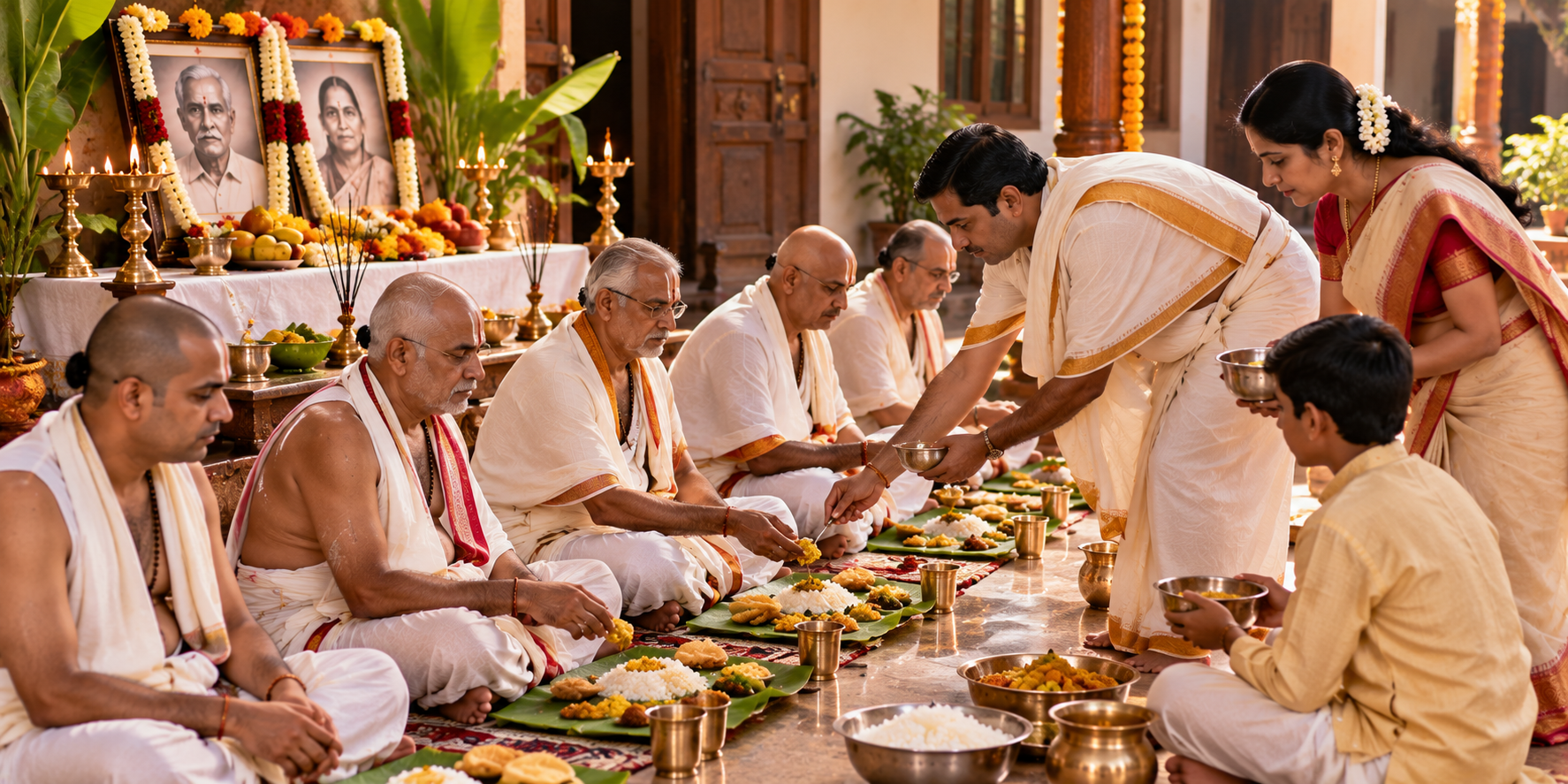
- The Shraddha meal: cooked for invited Brahmins, guests or elders, served first.
- Panchabali: small portions set out for the cow, dog, crow, ants and the gods.
- Food for the needy: meals or dry rations given in the ancestors' name.
- The family meal: eaten last, usually from the same food.
Beyond the day of the rite, many families adjust their everyday cooking for the whole fortnight: vegetarian only, often without onion and garlic, sometimes avoiding certain lentils or vegetables. Others keep ordinary diets except on Shraddha days.
Family custom often includes a signature dish, a grandfather's favourite dal or a grandmother's sweet, prepared every year. If your family has one, it is worth writing the recipe down. See writing a family record.
3 of 20
Simple Satvik Meal Ideas for Shraddha
A satvik meal emphasises fresh, lightly spiced, vegetarian food. Onion, garlic, mushrooms, very pungent spices, stale food and alcohol are traditionally excluded. Here are three simple menus that fit most household customs.
A classic North Indian thali
Kheer, puri, pumpkin sabzi with fenugreek and a touch of jaggery, arbi (colocasia) or potato sabzi without onion, plain dal, rice, cucumber raita.
A southern-style meal
Rice, a plain dal or paruppu, sambar made without onion, a kootu of pumpkin or ash gourd, a plantain poriyal, vadai if your tradition includes it, payasam.
A very simple meal
Kheer, puri and one seasonal vegetable. This is entirely sufficient.
Use ghee for cooking where possible, flavour with cumin, ginger, asafoetida (hing) and fresh coriander, and keep spice levels gentle. Some families avoid certain vegetables such as brinjal; see foods commonly avoided.
4 of 20
Kheer for Shraddha: Traditional Context and Simple Recipe
Kheer, rice slowly cooked in milk and sweetened, is perhaps the single most characteristic Shraddha dish in North India. Milk, rice and sugar together represent richness and nourishment, and kheer is often the first food portioned out for the ancestors and for crows.
Simple kheer (serves 4 to 6)
- 1 litre full-fat milk
- 3 to 4 tablespoons short-grain or basmati rice, washed and soaked 20 minutes
- 4 to 6 tablespoons sugar, to taste
- 4 green cardamom pods, crushed
- A few chopped almonds or cashews, and a pinch of saffron if liked
- Bring the milk to a boil in a heavy-bottomed pan.
- Add the drained rice and simmer on low heat, stirring often and scraping the bottom, for 30 to 40 minutes, until the rice is very soft and the milk has thickened.
- Stir in sugar and cardamom; simmer 5 minutes more.
- Add nuts and saffron. Serve warm or at room temperature.
Some families use jaggery instead of sugar (add it off the heat to avoid curdling) or make kheer with vermicelli. Taste only after the food has been offered, if that is your family's custom.
5 of 20
Puri and Seasonal Sabzi for Shraddha Meal: General Guide
Puri, small deep-fried wheat breads, are a standard part of the North Indian Shraddha meal, partly because they are festive and partly because food fried in ghee is traditionally considered suitable for offering.
Puri
Knead whole-wheat flour with a little salt, a spoon of ghee or oil, and enough water for a firm dough. Rest 15 minutes. Roll small, even discs and fry in hot ghee or oil until they puff and turn golden.
Seasonal sabzi
The Shraddha season coincides with the late-monsoon harvest of gourds. Two favourites:
- Pumpkin (kaddu) sabzi: cubed pumpkin cooked with cumin, fenugreek seeds, ginger, a little chilli, turmeric and a pinch of jaggery, finished with amchur or lemon.
- Colocasia (arbi) sabzi: boiled, peeled arbi sautéed with ajwain, cumin and mild spices.
Bottle gourd, ridge gourd and raw banana are also common. Cook without onion and garlic if that is your family's custom.
6 of 20
Dal and Rice Ideas for a Simple Shraddha Meal
Dal and rice make a complete, comforting Shraddha meal and suit families who prefer to keep things simple.
- Plain moong or arhar (toor) dal: cooked soft with turmeric and salt, tempered with ghee, cumin, hing and a little ginger. Moong is often considered especially light and pure.
- Urad dal: some traditions include urad preparations, such as dal or vadas, on Shraddha days; others avoid them. Follow family custom.
- Kadhi: yoghurt and gram-flour curry, a North Indian Shraddha favourite in many homes.
- Rice: freshly cooked plain rice, or in the south, rice served with ghee.
Masoor (red lentil) is avoided by many families during Shraddha, and in some traditions other lentils are avoided too, so ask elders if you are unsure.
A pot of dal, a pot of rice, a simple vegetable and a spoon of kheer or a sweet is a meal any ancestor would recognise.
7 of 20
Why Sesame Is Used in Shraddha Food and Ritual Offerings
Black sesame appears in the ritual (tarpan water, pindas) and often in the food as well, for the same reasons: tradition regards it as purifying and protective, associated with the ancestors, and deeply nourishing.
Ways sesame enters the meal:
- Til laddoos or sesame-jaggery sweets, particularly in North and West India.
- A sprinkle of toasted sesame on vegetables or in chutneys.
- Sesame oil for cooking in southern kitchens, where nallennai (gingelly oil) is traditional.
- Sesame mixed into pindas along with rice and ghee.
Sesame is also a common item of daan, given as a gift to priests or the needy, sometimes along with grain.
Practically, black sesame keeps well in an airtight jar and is easy to find in Indian and Asian stores abroad. See why sesame is used in rituals.
8 of 20
Why Some Families Avoid Onion and Garlic During Shraddha
Many Hindu families cook without onion and garlic on Shraddha days, and some for the whole fortnight. The custom draws on several ideas.
- Guna theory. In Ayurvedic and yogic classifications, foods are grouped by their effect on the mind. Onion and garlic are commonly classed as rajasic or tamasic, stimulating or dulling, rather than satvik, calming and pure. Ritual food is kept satvik.
- Ritual purity. Classical texts and later custom list various foods as unsuitable for offerings, and onion and garlic appear widely in such lists.
- Consistency with temple cooking. Many temple kitchens exclude them, and Shraddha food follows the same principle.
- Family habit. In many households it is simply what has always been done.
Not all families follow the rule, and some regional cuisines are less dependent on onion and garlic to begin with. Asafoetida (hing), ginger, cumin and tomatoes are the usual substitutes for depth of flavour.
9 of 20
Foods Commonly Avoided During Pitru Paksha in Some Traditions
The following are avoided by many families, but none is universal. Lists differ by region, community and household.
- Meat, fish and eggs: avoided by most observant families for Shraddha and often for the fortnight.
- Alcohol and tobacco: avoided.
- Onion and garlic: widely avoided. See why.
- Masoor dal and in some homes other lentils, such as chana or urad.
- Certain vegetables: brinjal, radish, carrot, and some gourds are avoided in particular traditions; others are specifically preferred.
- Stale, leftover or reheated food for the offering; it should be freshly cooked.
- Food already tasted before offering.
- Very pungent or heavily spiced dishes.
Some families also avoid buying new food items or eating out during the fortnight. If you are cooking for a family whose customs you do not know, a simple meal of kheer, puri and a pumpkin sabzi without onion and garlic is very widely acceptable.
10 of 20
How to Prepare Food Respectfully for a Shraddha Ritual
How the food is cooked matters as much, in traditional understanding, as what is cooked.
- Clean first. Clean the kitchen and utensils; many families use separate or freshly scoured vessels for Shraddha cooking.
- Bathe and dress in clean clothes before cooking.
- Cook in a calm frame of mind. Many families recite a prayer or keep the ancestor in mind while cooking; some avoid arguments or loud music in the kitchen.
- Do not taste the food before it is offered. Season by experience.
- Use good ingredients. Ghee, milk and fresh produce, as far as the budget allows.
- Cook enough for guests, animals, the needy and the family, and portion carefully.
- Serve on leaf plates or clean thalis; banana leaves and leaf plates (pattal) are traditional.
- Handle leftovers respectfully: share them with family, give to those in need or feed animals; avoid waste.
In many homes, the person cooking and the person performing the rite are different, and both roles are honoured as part of the offering.
11 of 20
What Is Offered to Crows During Shraddha?
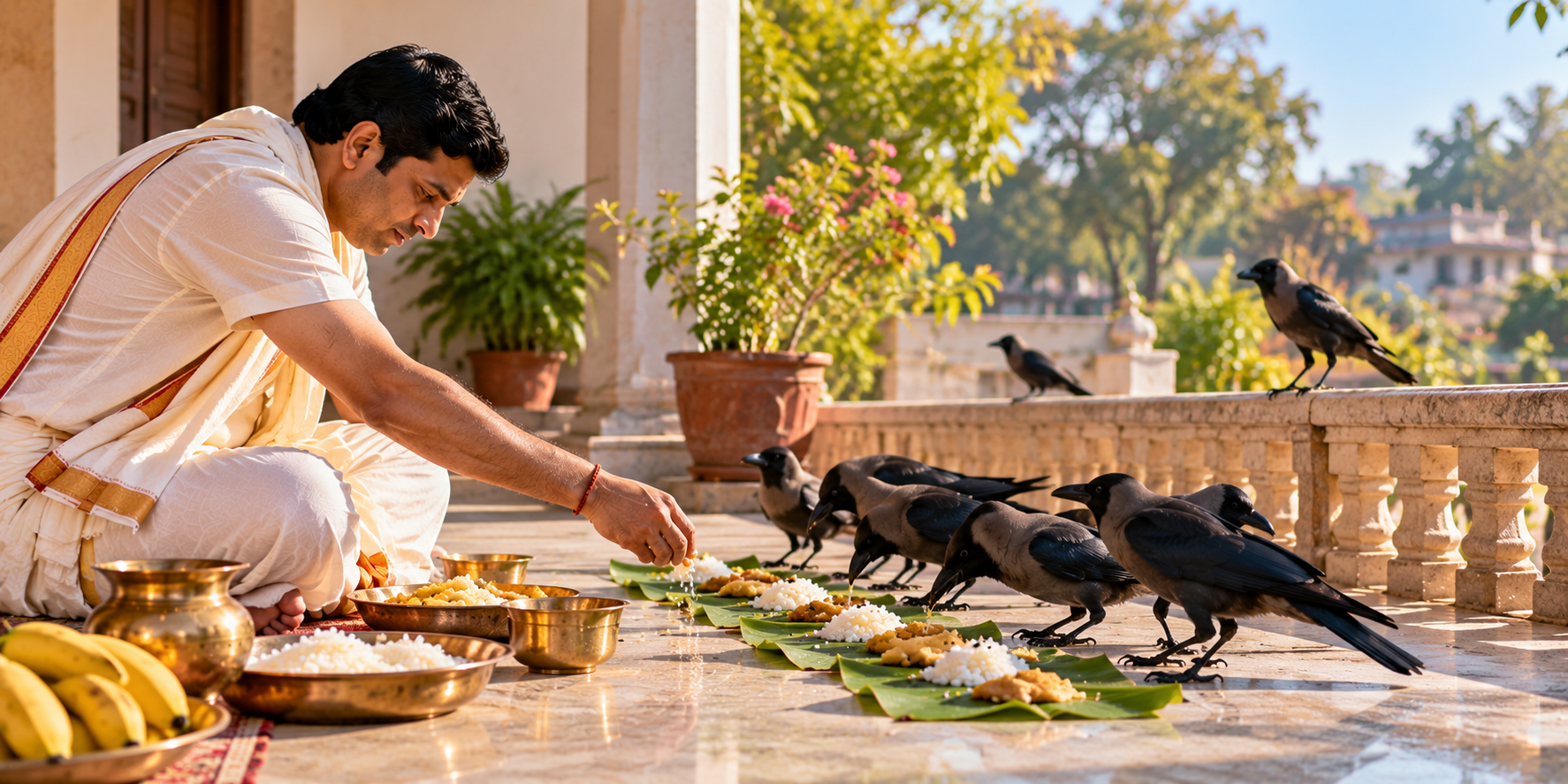
The crow's portion, kaak bali or kaka bali, is usually a small plate or leaf with a sample of the Shraddha meal: a spoon of kheer, a piece of puri, some rice mixed with ghee or dal, and sometimes a little of each dish. It is placed on a roof, terrace, wall or open ground, often before the family eats.
Families watch for crows to come and eat, and in many homes the family eats only after they have. The crow's acceptance is taken as a sign that the ancestors have accepted the offering. See why crows are associated with Shraddha.
In cities where crows are scarce, including many outside India, families offer the portion to any birds that visit, or place it in a park where birds feed, following any local rules on feeding wildlife. Avoid salty, heavily spiced or sugary food for wild birds where possible, and remove uneaten food later so it does not attract pests.

12 of 20
Feeding Cows During Shraddha: Traditional Meaning and Modern Practice
The go bali, the cow's portion, is part of panchabali. The cow is revered as a nourishing mother figure, and giving food to a cow is considered among the most meritorious acts in Hindu tradition. Pindas themselves are often given to a cow after the rite.
Traditionally, a cow is fed a chapati or puri with jaggery, some green fodder, or a portion of the meal. In villages and many towns this is easily done at a neighbour's cow or a temple cowshed.
In cities and abroad, families adapt:
- Donate to a gaushala (cow shelter), in India or locally where one exists, in the ancestor's name.
- Visit a temple that keeps cows, where feeding may be arranged.
- Give the portion to another animal or add it to the portion for birds.
Avoid feeding cows plastic-wrapped food, heavily spiced leftovers, or food that is unsafe for them; green fodder, chapati and jaggery in moderation are the traditional and safe choices.
13 of 20
Feeding the Needy During Pitru Paksha: Charity and Remembrance
Feeding people in need in the ancestors' name is one of the oldest and most widely shared ways to observe Pitru Paksha, and many priests describe it as the essence of the rite.
Ways families do it:
- Serve a meal at home to people in need, or distribute packed meals outside a temple.
- Donate dry rations: rice, flour, dal, sesame, oil, sugar.
- Sponsor a meal at a temple kitchen, ashram, school, orphanage or old-age home.
- Give to a food bank or community kitchen abroad, perhaps one the ancestor would have supported.
- Pay for a meal for workers or staff who serve your family.
Some families choose a cause connected to the ancestor's life: a grandfather who was a teacher might be remembered through meals at a school.
The principle, shared across regions, is that the ancestors are satisfied when the living are fed. See why charity is connected with Shraddha.
14 of 20
Shraddha Meal for a Small Family at Home
A small family, even a single person, can offer a complete Shraddha meal without strain.
A practical plan for two to four people
- Cook: a small pot of kheer, six to eight puris, one seasonal vegetable, and dal and rice if you like.
- Portion before eating: a small plate for the ancestors (placed near their photograph or in the ritual space), a portion for crows or birds, a chapati or puri for a cow or other animal, and a portion for ants (a few grains of rice or sugar outside).
- Guest: invite a priest, an elder or a friend if you can; if not, set aside a plate to give to someone in need later that day.
- Family meal: eat together, sharing memories.
The ancestors' plate is traditionally given to a cow or bird afterward or consumed by the family, according to custom.
It is also fine to do less. Kheer and a single puri offered with sincerity are, in the tradition's own terms, a complete gift.
15 of 20
Shraddha Meal Planning for a Larger Family Gathering
When relatives gather for a parent's or grandparent's Shraddha, the meal becomes a small event.
- Confirm numbers a week ahead, including priests, guests and anyone you plan to feed.
- Keep the menu tight: kheer, puri, two vegetables, dal or kadhi, rice, raita and one sweet is generous for most gatherings.
- Assign roles: who cooks which dish, who handles the rite, who serves guests, who looks after animal portions and daan.
- Prep the day before what can be prepared safely: chopping, dough, dry spice mixes. Cook the offering fresh on the day.
- Serve in order: offering and panchabali first, then priests and guests, then family.
- Plan for leftovers: arrange to share them with neighbours, staff or a community kitchen.
- Keep food safe: see food hygiene.
Involve the younger generation: children can shape puris, set out leaf plates or carry the crow's portion to the roof, and these small roles become memories. See involving children.
16 of 20
Pitru Paksha Meal Ideas for Families Living Abroad
Families outside India often face missing ingredients, small kitchens and weekday schedules. The tradition adapts well.
- Pumpkin and squash are widely available in September in North America, Europe and Australia; butternut or acorn squash works well in a kaddu sabzi.
- Kheer needs only rice, milk and sugar; any long-grain rice works.
- Puri can be made with atta from Indian grocers, or replaced with fresh chapatis or parathas.
- Black sesame is sold in Asian supermarkets.
- Banana leaves are often available frozen in Asian stores; paper plates are an acceptable substitute.
- Satvik without onion or garlic: use asafoetida (hing), ginger, cumin and tomatoes for flavour.
On weekdays, many families cook kheer the night before (it keeps well refrigerated, though some families prefer fresh on the day) and make puri and one vegetable after work. The crow's portion can go to local birds, the cow's portion to a donation, and a meal to a local food bank in the ancestor's name. See vegetarian ideas with easy ingredients.
17 of 20
Vegetarian Shraddha Food Ideas Using Easily Available Ingredients
You can cook a fitting Shraddha meal with what most supermarkets anywhere carry.
- Sweet: rice kheer; semolina (suji) halwa with ghee and sugar; sesame-jaggery laddoos.
- Bread: puri or chapati from whole-wheat flour.
- Vegetables: pumpkin or squash with cumin and a little jaggery; potatoes with cumin and coriander (no onion); green beans or courgette with mustard seeds; spinach cooked simply with ginger.
- Lentils: moong dal (split yellow mung) or toor dal, tempered with ghee, cumin and hing.
- Rice: plain steamed rice or a simple jeera rice.
- Yoghurt: cucumber raita.
A balanced menu might be kheer, chapati, pumpkin sabzi, moong dal, rice and raita. It is vegetarian, satvik, and entirely recognisable as a Shraddha meal.
If you are unsure about a particular vegetable, ask an elder or simply choose one of the most widely used: pumpkin, potato or bottle gourd.
18 of 20
Can Packaged or Restaurant Food Be Used for Shraddha?
Traditionally, the Shraddha offering should be cooked at home, fresh, by the family, and many families hold to this firmly.
That said, circumstances vary. Elderly people living alone, those who are unwell, families in hostels or temporary housing, or those travelling may not be able to cook. Priests commonly suggest these approaches:
- Cook something small yourself if at all possible: kheer or even a bowl of rice with ghee and sesame for the offering, while buying the rest of the meal.
- Buy from a temple kitchen or a vegetarian caterer who cooks without onion and garlic, if your family follows that custom.
- Use sweets from a trusted sweet shop for daan or for guests, which many families do anyway.
- Offer uncooked food: fruit, milk, dry rations or sesame, which some traditions accept when cooked food is not possible.
Packaged or restaurant food is generally not used for the pindas or the ancestors' portion. When in doubt, ask your priest; most will find a practical solution.
19 of 20
Food Hygiene and Safe Serving During Family Shraddha Gatherings
Shraddha meals are often cooked in quantity, served to elderly relatives, and sometimes left out while the rite is performed. A few precautions protect everyone.
- Keep hot food hot and cold food cold. Milk-based dishes like kheer and raita spoil quickly in warm weather; refrigerate if they will wait more than about two hours, less in hot climates.
- Cool and store leftovers promptly in shallow containers.
- Wash hands before cooking and serving, and between handling raw produce and cooked food.
- Mind allergies and diets. Ask guests about allergies (nuts in kheer are common) and dietary needs such as diabetes; offer a less-sweet option.
- Serve safely to animals: avoid chocolate, onion, garlic and heavily salted food for dogs; avoid plastic near cows.
- Keep lamps and incense away from cloth, leaf plates and children.
- Plan for heat in places like the Gulf or during late-season heat in India: cook close to serving time.
Care for guests is itself part of the rite.
20 of 20
Shraddha Food FAQ: Offerings, Ingredients, Customs and Variations
Can I taste the food while cooking?
Many families avoid tasting before the offering. If you need to, set aside the offering portion first.
Can I use store-bought ghee and milk?
Yes.
Is tulsi used in Shraddha food?
Many families add tulsi to offerings; some traditions omit it for ancestral rites. Follow family custom.
Can the family eat the ancestors' portion?
In many homes the ancestors' plate is given to a cow or bird; in others it is shared by the family as prasad. Both are found.
Should the meal be served on banana leaves?
It is traditional in many regions, but clean steel plates or leaf plates are fine.
Is it acceptable to cook the ancestor's favourite non-vegetarian dish?
Most families keep Shraddha food vegetarian. Some remember a favourite dish on another occasion or cook a vegetarian version.
How long can kheer be kept?
About a day refrigerated. Offer it fresh on the day of the rite if possible.
Frequently asked questions
What food is cooked for Shraddha?
Typically a fresh vegetarian satvik meal such as kheer, puri, a seasonal vegetable like pumpkin or gourd, dal and rice, though menus vary by region and family.
Why is onion and garlic avoided during Shraddha?
They are commonly classed as non-satvik foods and excluded from ritual cooking in many traditions. Not all families follow the rule.
What is offered to crows during Shraddha?
A small portion of the meal, usually kheer, puri and rice, placed in an open space. Crows eating it is taken as a sign that the offering has been accepted.
Can Shraddha food be bought from a restaurant?
Traditionally it is cooked fresh at home. When that is impossible, many priests accept a small home-cooked offering with bought food for the rest, or uncooked offerings such as fruit and grain.
Which foods are avoided during Pitru Paksha?
Commonly meat, eggs, alcohol, onion, garlic, masoor dal, stale food and in some families certain vegetables. Lists vary by tradition.
How can families abroad cook a Shraddha meal?
With supermarket staples: kheer from rice and milk, chapati or puri, pumpkin or squash sabzi, moong dal and rice, flavoured with hing, cumin and ginger instead of onion and garlic.