Contents: 20 topics
- Pitru Paksha: Complete Guide to Meaning, Traditions and Shraddha Rituals
- What Is Shraddha? Meaning, Purpose and Hindu Ancestral Traditions
- Shraddha vs Pitru Paksha: What Is the Difference?
- Why Is Pitru Paksha Observed? Meaning and Cultural Significance
- Why Do Families Perform Shraddha for Ancestors?
- What Does Pitru Mean in Hindu Tradition?
- How Long Is Pitru Paksha and Why Does It Last a Fortnight?
- What Happens During Pitru Paksha? A Beginner’s Guide
- The Spiritual Meaning of Remembering Ancestors During Pitru Paksha
- Pitru Paksha Traditions: Tarpan, Pind Daan, Food Offerings and Remembrance
- Why Is Water Offered to Ancestors During Shraddha?
- Why Are Sesame Seeds Used in Shraddha and Tarpan?
- Why Is Kusha Grass Used in Shraddha Rituals?
- Why Are Crows Associated with Shraddha Offerings?
- Why Is Food Offered During Shraddha?
- Who Can Perform Shraddha? Traditional Practice and Modern Family Contexts
- Can Shraddha Be Performed at Home?
- Pitru Paksha for Beginners: Customs, Etiquette and Common Questions
- Shraddha Myths vs Common Traditions
- 50 Frequently Asked Questions About Shraddha and Pitru Paksha
- Frequently asked questions
Every year, in the dark half of the lunar month that falls in September or early October, millions of Hindu families set aside about two weeks to remember those who came before them. The period is called Pitru Paksha, the fortnight of the ancestors, and the rites performed within it are called Shraddha.
This guide brings together twenty questions that people most often ask when they first meet the tradition, whether they grew up with it and never asked why, are marrying into a family that observes it, or are simply curious. It explains the vocabulary, the logic of the calendar, the core rituals and the meaning behind the objects used. Each section can be read on its own, and the contents list lets you jump straight to the question you have.
For the 2026 calendar, see the dates and timing guide. For step-by-step ritual detail, see the rituals guide.
Key takeaways
- Pitru Paksha is the period; Shraddha is the rite. You can perform Shraddha on other days too, such as a death anniversary.
- In the 2026 New Delhi reference, Purnima Shraddha is 26 September, the main Pratipada sequence begins 27 September, and Sarva Pitru Amavasya is 10 October. Check the full calendar.
- The core acts are tarpan (water with sesame), pind daan (rice balls), feeding (Brahmins, cows, crows, dogs, the needy) and daan (charity).
- Each ancestor is traditionally remembered on the tithi (lunar day) on which they died; Sarva Pitru Amavasya covers everyone.
- Practice varies widely. Family custom and the guidance of a trusted priest take precedence over any general guide.
1 of 20
Pitru Paksha: Complete Guide to Meaning, Traditions and Shraddha Rituals
Pitru Paksha (also written Pitri Paksha, and called Shraddha Paksha, Mahalaya Paksha or simply "Shraadh" in everyday Hindi) is a lunar fortnight dedicated to ancestors. It begins with the full moon (Purnima) of the month of Bhadrapada and ends on the following new moon (Amavasya), known as Sarva Pitru Amavasya or Mahalaya Amavasya. In the Gregorian calendar it usually falls in September, sometimes stretching into early October.
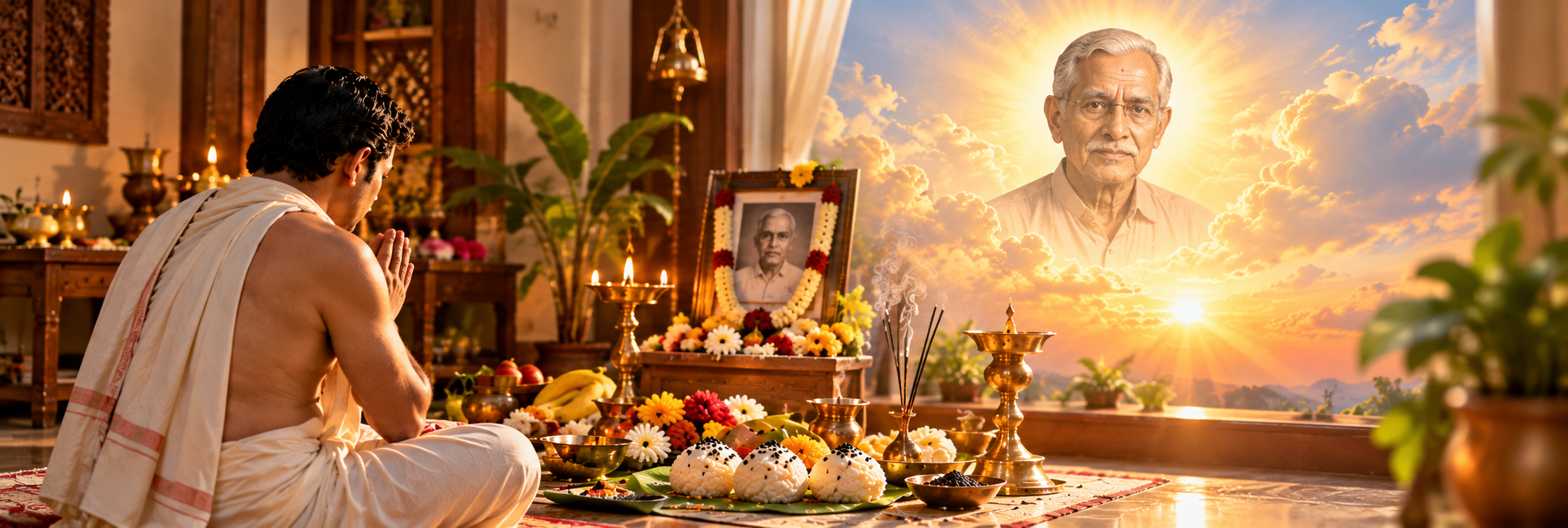
During this period families perform Shraddha: offerings of water, sesame, rice balls and food, made with prayer and gratitude to deceased parents, grandparents and wider lineage. Each ancestor is traditionally honoured on the lunar day (tithi) of their death, and the final new-moon day serves as a collective day for all ancestors, including those whose date is unknown.
The fortnight is treated as a time of restraint. Many families avoid weddings, housewarmings and major purchases, eat simple vegetarian food, and give food and charity. Its tone is quiet and reflective rather than festive, and in much of India it leads directly into Navratri, which begins the day after it ends.
The rest of this guide unpacks each piece of that summary.
2 of 20
What Is Shraddha? Meaning, Purpose and Hindu Ancestral Traditions
The Sanskrit word śrāddha comes from śraddhā, meaning faith, trust or sincere conviction. Classical definitions describe Shraddha as whatever is offered to the ancestors with faith, at the proper time and place, to the proper recipients. The emphasis on sincerity is important: the rite is understood as an act of the heart as much as a sequence of steps.
In practice, Shraddha is a set of rites for deceased family members. A full Shraddha typically includes a statement of intent (sankalpa), invocation of the ancestors, offerings of water with sesame (tarpan), rice balls (pinda), a meal served to invited Brahmins or guests, portions set aside for animals, and gifts (dakshina and daan).
Shraddha is not limited to Pitru Paksha. Many families perform an annual Shraddha on each parent's death anniversary by the lunar calendar, and some observe monthly Amavasya offerings. Pitru Paksha is the season when these obligations are gathered together, which is why the two words are often used interchangeably. See Shraddha vs Pitru Paksha for the distinction.
3 of 20
Shraddha vs Pitru Paksha: What Is the Difference?
The simplest way to hold the difference: Shraddha is what you do; Pitru Paksha is when many people do it.
- Shraddha is the ritual act of offering to ancestors. It can be performed on a death anniversary, on Amavasya, at a pilgrimage site such as Gaya, or during Pitru Paksha.
- Pitru Paksha is a specific fortnight in the lunar calendar, from Bhadrapada Purnima to the following Amavasya, set aside especially for ancestral rites.
Because nearly every Hindu household that observes ancestral rites does so during this fortnight, the period itself is often called "Shraadh" or "the Shraadhs" in North India. Someone might say "we don't buy new things during Shraadh," meaning the fortnight, not the ritual.
A family may therefore perform two Shraddhas for the same parent each year: the annual death-anniversary rite (sometimes called varshik or pratyabdika Shraddha) and the Mahalaya Shraddha during Pitru Paksha. Other families fold the two together. Both are recognised practices. For more comparisons like this, see the comparisons guide.
4 of 20
Why Is Pitru Paksha Observed? Meaning and Cultural Significance
Several threads of meaning come together in Pitru Paksha.
Gratitude and continuity. Hindu thought describes each person as born with obligations, including one to the ancestors who gave them life, name and inheritance. Offering Shraddha is a way of acknowledging that debt. See Pitru Rina.
Care for the departed. Traditional belief holds that ancestors dwell in a realm of their own (Pitru Loka) and are nourished and satisfied by the offerings of their descendants. Many families describe the fortnight as a time when ancestors are especially close.
Seasonal timing. The period falls around the autumn equinox, while the sun is in Kanya (Virgo); older texts single out Shraddha offered while the sun is in Kanya as especially valued, which is one reason the season is also called Kanyagata. It also falls just before the goddess festivals of Navratri and Durga Puja. The move from remembering the dead to celebrating the Goddess gives the calendar a strong emotional rhythm.
Family memory. Beyond belief, the fortnight gathers families, prompts storytelling and keeps names alive. Many people who are not ritually observant still mark it for this reason.
5 of 20
Why Do Families Perform Shraddha for Ancestors?
Families give different reasons, and most hold several at once.
- Duty. Many see Shraddha as a responsibility passed from parent to child, part of the householder's dharma. Performing it is simply what a good son, daughter or grandchild does.
- Gratitude. Everything a family has, from its name to its land and values, came through earlier generations. Shraddha says thank you.
- Peace for the departed. Traditional teaching holds that offerings bring satisfaction (tripti) to the ancestors and ease their onward journey.
- Blessings for the living. A contented ancestor is believed to bless the household with health, children and prosperity; neglect, in popular belief, can bring difficulty. This idea is sometimes discussed as pitru dosha, a concept best approached with care rather than fear.
- Grief and remembrance. For a family that has recently lost someone, the rite gives shape to mourning and a sanctioned time to remember together.
None of these motives requires the others. A family that sees Shraddha mainly as remembrance and a family that sees it as spiritual necessity can perform essentially the same rite.
6 of 20
What Does Pitru Mean in Hindu Tradition?
Pitṛ (plural pitaraḥ, anglicised as pitr, pitru or pitri) literally means "father", but in ritual use it means the ancestors as a group: the departed forebears of a family who are honoured with offerings.
The Rigveda already addresses the pitrs as a class of beings invited to sacrifice, and later texts describe them as residing in Pitru Loka, the world of the fathers. Ritual tradition usually names three immediate generations on the father's side, father, grandfather and great-grandfather, and often the corresponding mothers and maternal lines as well. Beyond these named generations, offerings are also made for the wider, unnamed lineage.
Texts also speak of divine pitrs, such as the Agnishvattas and Barhishads, who are ancestral powers presiding over the whole category. For most families, though, "pitru" simply means "our people who have passed on".
Although the word is grammatically masculine, in practice mothers, grandmothers and other women ancestors are fully included, and some days of Pitru Paksha, such as Matru Navami, are specifically associated with them.
7 of 20
How Long Is Pitru Paksha and Why Does It Last a Fortnight?
Pitru Paksha lasts one paksha, the lunar fortnight from full moon to new moon. Counting the Purnima day at the start, it spans about sixteen lunar days, which is why many families speak of "sixteen Shraddhas" (Nepal calls the period Sorha Shraddha). In Gregorian days it may be fifteen or sixteen, and occasionally a day is compressed or doubled because lunar days do not align exactly with solar days.
Why a fortnight? The waning half of the moon is traditionally associated with the ancestors, and each of its fifteen tithis gives a slot for those who died on that lunar day. Texts describe a day of the pitrs as equal to a human month, with the dark fortnight as their daytime, making it the natural time to offer them food.
In the 2026 New Delhi reference, Purnima Shraddha is Saturday, 26 September, the main Krishna Paksha sequence begins with Pratipada on Sunday, 27 September, and Sarva Pitru Amavasya is Saturday, 10 October. Exact dates can shift by location, so confirm with a local Panchang. The 2026 calendar lists every day.
8 of 20
What Happens During Pitru Paksha? A Beginner’s Guide
If you are new to the tradition, here is what a typical household might do, bearing in mind that every family differs.
- Before it begins, families check the Panchang for their ancestors' tithis, contact a priest if one is needed and plan meals.
- On an ancestor's tithi, usually around midday or early afternoon, the person performing the rite bathes, sits facing south, makes a sankalpa, and offers tarpan and often pinda. A simple vegetarian meal is cooked, with portions set aside for a cow, a crow, a dog and ants. Invited Brahmins, elders or guests are fed, and gifts are given.
- Throughout the fortnight, many families eat simple satvik food without onion or garlic, avoid celebrations and new purchases, and some men avoid haircuts and shaving.
- On Sarva Pitru Amavasya, families offer Shraddha for all ancestors together, especially anyone whose tithi is unknown or was missed.
Pilgrims travel to Gaya, Haridwar, Varanasi and other sites to perform pind daan. See what happens at pilgrimage sites and a fuller at-home overview.
9 of 20
The Spiritual Meaning of Remembering Ancestors During Pitru Paksha
Beneath the ritual detail lies a simple spiritual idea: the living and the dead remain connected, and that connection is kept alive by attention and giving.
Hindu philosophy generally teaches that the self continues beyond death, whether toward rebirth, toward the world of the ancestors or toward liberation. Shraddha places the family inside that larger picture. The offerings are understood not as feeding a body but as sending nourishment, gratitude and goodwill across a boundary.
For many practitioners, the fortnight is also a practice of humility. Sitting on the ground, facing south, offering water through the fingers and naming three generations reminds a person that they are one link in a long chain. Their own name will one day be spoken by descendants in the same way.
Remembering is itself treated as sacred. Speaking an ancestor's name, telling their story and sharing food in their memory are, in this understanding, not merely sentimental; they are part of the offering. That is why even families who cannot perform a full rite are encouraged to remember ancestors in simpler ways.
10 of 20
Pitru Paksha Traditions: Tarpan, Pind Daan, Food Offerings and Remembrance
Four practices form the backbone of most observances.
Tarpan
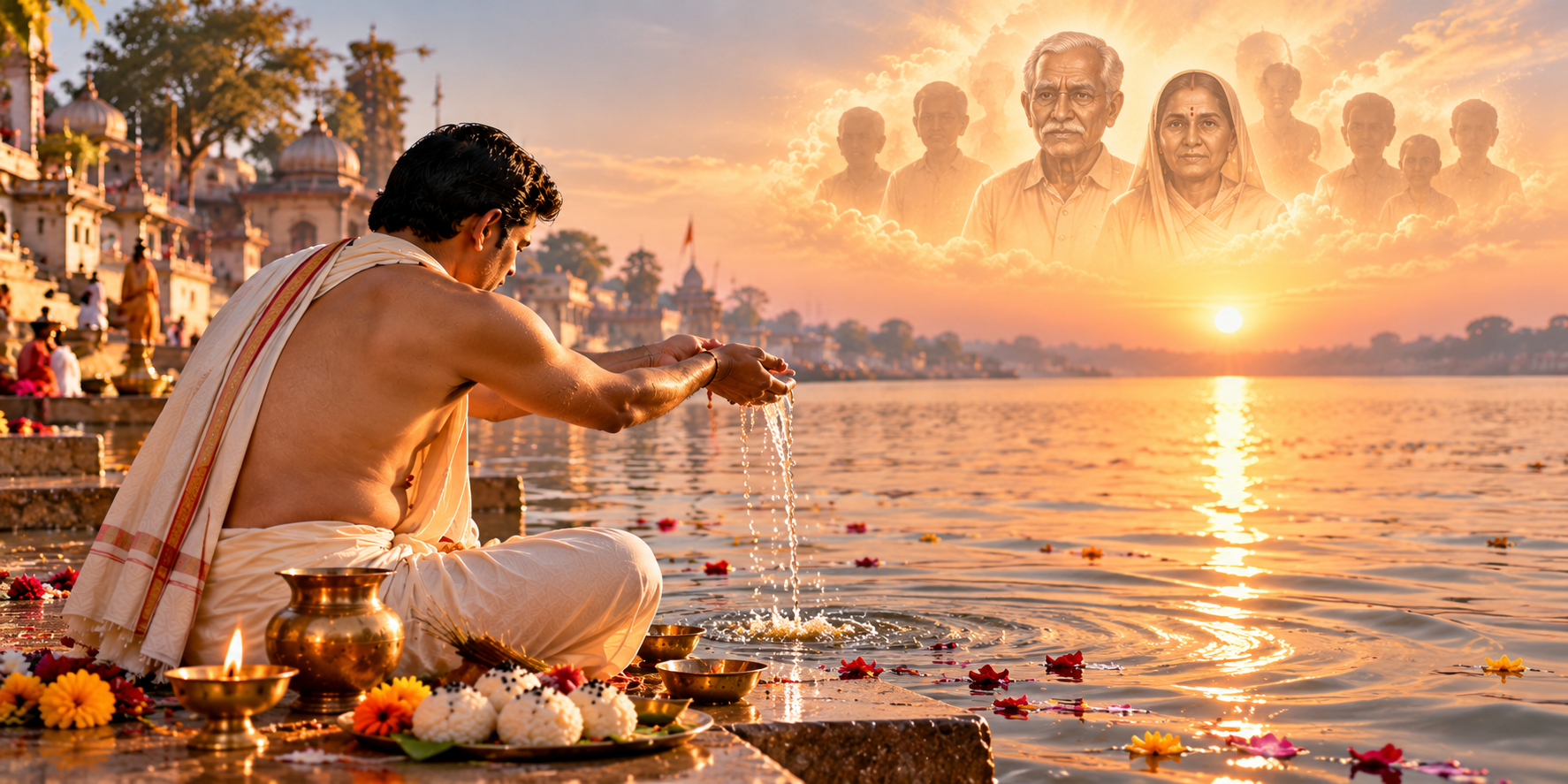
The offering of water, usually mixed with black sesame, poured with a prayer. The word means "satisfying". It is the simplest rite and can be performed daily through the fortnight. See tarpan in detail.
Pind daan
The offering of pindas, balls usually made of cooked rice or barley flour with sesame, ghee and honey, symbolically representing nourishment for the ancestors. It is central to full Shraddha and to pilgrimages at Gaya. See pind daan.
Food offerings
A meal is prepared with care, commonly including kheer, puri and seasonal vegetables. Portions go to invited Brahmins or guests, to animals such as cows, crows and dogs, and often to the needy. See the food guide.
Remembrance and charity
Naming ancestors, recalling their lives, and giving daan (food, clothing, money, sesame, grain) in their memory complete the observance. Many families today place as much weight on this as on the formal rite.
11 of 20
Why Is Water Offered to Ancestors During Shraddha?
Water is the most basic offering in Hindu ritual, and in Shraddha it carries special meaning.
It satisfies thirst. Tarpan literally means "that which satisfies". The texts imagine the ancestors as needing water, just as the living do, and descendants as the ones who provide it. Even when nothing else can be offered, water with sesame is considered sufficient for a basic observance.
It connects the worlds. Water flows, carries and dissolves. Offering it into a river or onto the ground is understood as sending it onward. Many pilgrimage rites take place at rivers such as the Ganga at Haridwar and Varanasi, the Phalgu at Gaya and the confluence at Prayagraj for this reason.
It purifies. Bathing before the rite and sprinkling water on the ritual space prepare body and place.
The manner of offering is distinctive: in many traditions water for ancestors is poured over the part of the palm between thumb and forefinger (the pitru tirtha), rather than over the fingertips used for offerings to deities. See how water tarpan is offered and the symbolism of water.
12 of 20
Why Are Sesame Seeds Used in Shraddha and Tarpan?
Black sesame (til) is so closely tied to ancestral rites that tarpan is often called til tarpan.
Tradition gives several reasons. In a well-known account, sesame is said to have arisen from the sweat of Vishnu, making it purifying and protective, and texts state that sesame keeps away disruptive forces from the offering. Its dark colour is associated with the ancestors and the southern direction. Sesame is also an ancient Indian crop, a source of oil and nourishment, and so a natural symbol of sustenance.
Practically, sesame appears in the water of tarpan, in pindas and in foods cooked for the meal, and is commonly given as daan. Some families use white sesame, and in some rites for deities white sesame is preferred while black is reserved for ancestors.
If black sesame is unavailable, as sometimes happens outside India, families generally use what they can find. Most priests consider sincerity more important than a specific seed. See also the symbolism of sesame and sesame in food offerings.
13 of 20
Why Is Kusha Grass Used in Shraddha Rituals?
Kusha (also darbha; Desmostachya bipinnata and related grasses) is a sacred grass used across Vedic ritual, and it is indispensable in many Shraddha traditions.
It appears in several forms. A ring of kusha (the pavitri) is worn on the ring finger of the right hand to mark the wearer as ritually prepared. Blades of kusha are laid on the ground as seats for the invoked ancestors and beneath the pindas. Kusha is also used to sprinkle water and to define the ritual space.
The reasons given are purity and protection. Kusha is said to have been sanctified by contact with the nectar of immortality in the Garuda legend, and it is believed not to transmit ritual impurity. Some interpretations see its sharp blades as a boundary guarding the offering.
Outside India, fresh kusha can be hard to find. Temples sometimes supply it during Pitru Paksha, and some families keep dried kusha from year to year. Where none is available, many priests permit a simple substitute or proceed without it. See the symbolism of kusha.
14 of 20
Why Are Crows Associated with Shraddha Offerings?
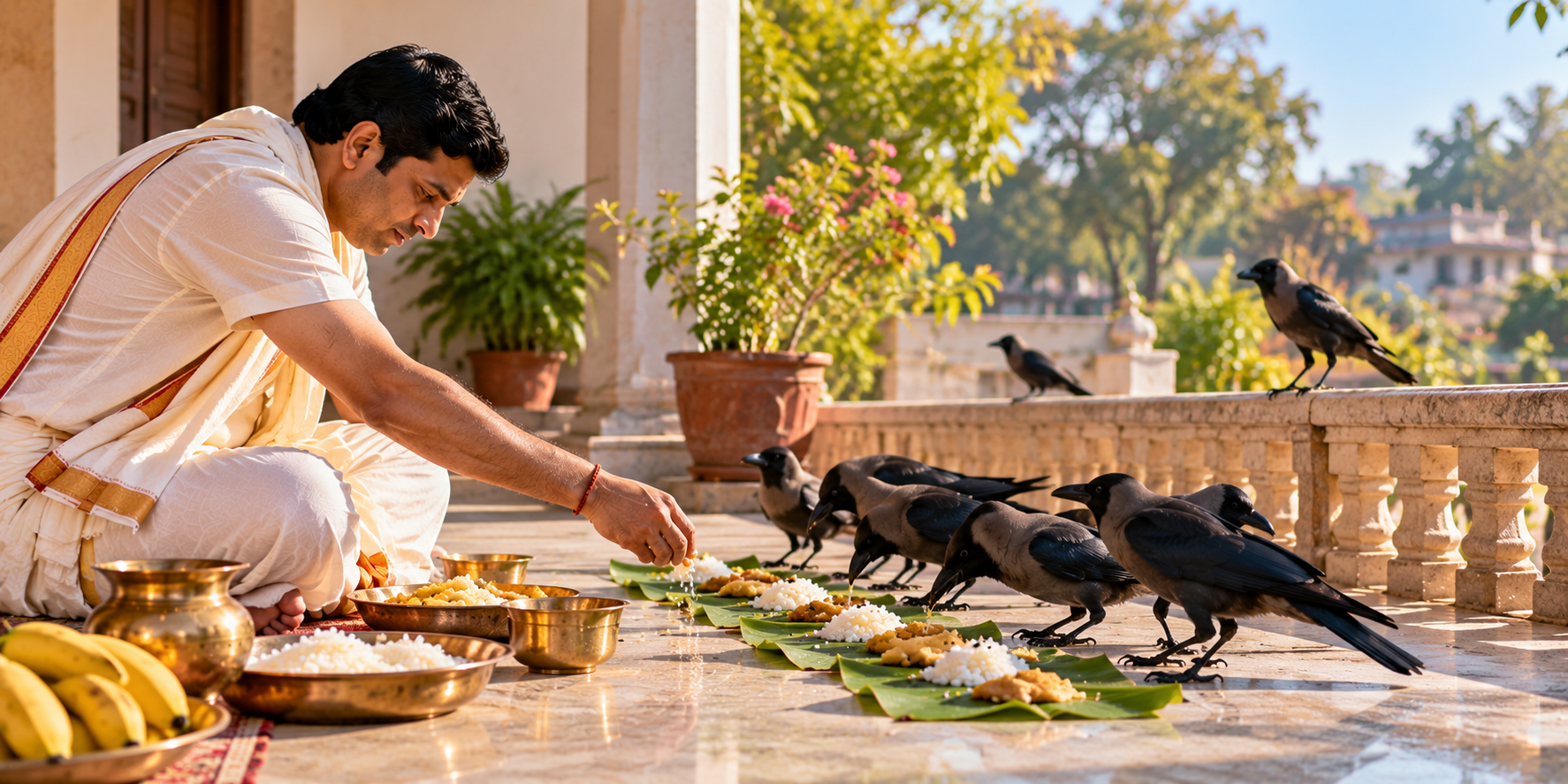
In many parts of India the sight of a crow eating from the Shraddha plate is treated as a sign that the ancestors have accepted the offering. The portion set out for crows is called kaak bali (or kaka bali).
Several traditions explain the link. Crows are widely regarded as messengers between the worlds and, in popular belief, as associated with Yama, the lord of death, or even as forms through which ancestors visit. Popular retellings add stories of a boon under which food given to crows reaches the ancestors; these are best read as folk tradition rather than as fixed scripture.
There is also an ecological reading. Crows are intelligent, ever-present urban birds, and feeding them alongside cows, dogs and ants expresses the idea that Shraddha nourishes all beings, not only humans.
Families often wait for a crow to come before they themselves eat. If no crow comes, most traditions do not treat this as a bad omen in any serious sense, and the food is offered to other birds or animals. In cities abroad, where crows may be absent, families feed whatever birds are present. See what is offered to crows.

15 of 20
Why Is Food Offered During Shraddha?
Food sits at the heart of Shraddha because, in the tradition's own logic, ancestors are nourished through what the living give.
The texts describe the pitrs as receiving the subtle essence of food offered with the proper mantras and intention. The pindas are one channel; the meal served to invited Brahmins or guests is another, as the guests are treated as representatives of the ancestors. Portions given to cows, crows, dogs and ants, and meals given to the poor, extend the same nourishment outward.
Food also carries memory. Many families cook the dishes a grandparent loved, and in some households the Shraddha meal is the one day a particular regional recipe is still made.
Typical Shraddha food is vegetarian and satvik, often without onion and garlic, and commonly includes rice or kheer, puri, dal and seasonal vegetables such as pumpkin or gourd. It is cooked fresh and with care, and the first portions are set aside before anyone eats. Details differ widely. The food guide covers menus, customs and practical planning.
16 of 20
Who Can Perform Shraddha? Traditional Practice and Modern Family Contexts
Traditionally, Shraddha is performed by the eldest son, or in his absence another son, a grandson or a male relative of the same lineage. Many classical texts also recognise others, including a wife for her husband, a daughter's son, a brother, a disciple or a family priest acting on the family's behalf, when no son is available.
Modern practice is broader. In many families today, daughters perform Shraddha for their parents, sometimes with a priest's guidance and sometimes without. Wives, sisters and granddaughters also take part fully. Some traditions and priests still restrict certain parts of the rite to men, and a family may choose to respect that; others see no conflict. Both approaches exist within living Hinduism.
What matters most in most families' understanding is that the rite is performed sincerely by someone who cares for the ancestor. If you are unsure what your family's tradition allows, ask elders or a priest from your community. See can women perform Shraddha and can daughters perform Shraddha.

17 of 20
Can Shraddha Be Performed at Home?
Yes. Most Shraddha is performed at home, and it always has been. Pilgrimage sites such as Gaya add special merit in tradition, but they are not required.
A home Shraddha needs a clean space, ideally where the performer can sit facing south; water, black sesame and, if available, kusha grass; rice or flour for pindas if they are offered; a freshly cooked vegetarian meal; and a way to give portions to animals and food or money to those in need. A priest can guide the rite in person or remotely, or the family can follow a simple sequence themselves.
Families in apartments, or living outside India, adapt freely: tarpan water is poured into a bowl and later given to a plant or the earth, pindas are placed in a clean vessel and later given to a cow, a river or buried, and animal portions go to birds in the park.
For the sequence, see how to perform Shraddha at home; for small spaces, observing Pitru Paksha in an apartment.
18 of 20
Pitru Paksha for Beginners: Customs, Etiquette and Common Questions
A few customs are widely, though not universally, observed. Treat them as a starting point to discuss with your family.
- Keep a sober tone. It is a period of remembrance, so loud celebrations, parties and festive shopping are usually avoided.
- Eat simply. Many households cook vegetarian food without onion or garlic, and some avoid certain lentils or vegetables.
- Postpone auspicious beginnings. Weddings, engagements, housewarmings and major purchases are commonly deferred. See weddings during Pitru Paksha.
- Personal grooming. Some men in North India do not cut hair or shave during the fortnight, or on the day they perform Shraddha.
- Feed and give. Offering food to animals and the needy is encouraged throughout.
If you are invited to someone's Shraddha, dress modestly in plain colours, arrive on time, eat what is offered without comment, and avoid photography unless the family invites it. See guest etiquette. If you are new to a family's tradition, a simple question, "what does your family do?", is always welcome.
19 of 20
Shraddha Myths vs Common Traditions
A few popular beliefs deserve a gentler, more accurate framing.
- "Anything new bought during Pitru Paksha brings bad luck." Many families avoid major purchases, but this is custom, not a universal scriptural rule. Essentials are bought as needed.
- "If a crow does not eat the food, the ancestors are angry." Crow feeding is a meaningful custom, but the absence of a crow on a given day is not generally treated by priests as a sign of anger.
- "Only a son can perform Shraddha." Traditional preference for sons is real, but texts list alternatives and many families today have daughters perform the rite.
- "Missing Shraddha brings a curse." The idea of pitru dosha exists in astrological practice, but fear-based framing is not necessary. Sarva Pitru Amavasya and later dates provide remedies for missed rites. See what if you miss it.
- "Shraddha must be done at Gaya." Gaya is especially revered, but home Shraddha is the norm.
The common thread is that custom varies, and ancestral rites are meant to comfort and connect, not frighten.
20 of 20
50 Frequently Asked Questions About Shraddha and Pitru Paksha
Rather than repeating answers found elsewhere in this guide, here is a quick-reference map of the most common questions and where each is answered in depth.
About the tradition
- What is Shraddha? Meaning and purpose
- Who are the pitrs? What pitru means
- Is Pitru Paksha a festival? Remembrance rather than celebration
Dates and days
- When is Pitru Paksha 2026? 15 to 29 September in India. Full calendar
- How do I find my ancestor's day? Choosing the tithi
- What if I do not know the date? Unknown tithi
The rite
- How is it done at home? Step-by-step overview
- What items are needed? Samagri list
- Can it be done without a priest? Without a priest
Food and customs
- What is cooked? Food traditions
- What should be avoided? What to avoid
For a longer list, see 100 questions and answers and the glossary.
Frequently asked questions
What is the difference between Shraddha and Pitru Paksha?
Shraddha is the ritual offering to ancestors. Pitru Paksha is the lunar fortnight, from Bhadrapada Purnima to the following Amavasya, when families especially perform it.
When is Pitru Paksha in 2026?
In the New Delhi reference, Purnima Shraddha is Saturday 26 September 2026, the main Pratipada sequence begins Sunday 27 September, and Sarva Pitru Amavasya is Saturday 10 October. Confirm with a local Panchang, as dates can shift by location.
What are the main rituals of Pitru Paksha?
Tarpan (offering water with sesame), pind daan (offering rice balls), feeding invited guests, animals and the needy, and giving charity, all performed with remembrance of the ancestors by name.
Can Shraddha be done at home without going to Gaya?
Yes. Most Shraddha is performed at home. Pilgrimage sites such as Gaya are considered especially meritorious but are not required.
Why are crows fed during Shraddha?
Crows are traditionally seen as messengers linked to the ancestors, and their eating from the offering is taken as a sign of acceptance. Feeding them also expresses the idea of nourishing all beings.
Can women and daughters perform Shraddha?
Traditional texts prefer sons but list alternatives, and many families today have daughters, wives or granddaughters perform the rite. Practice varies by family and priest.