Contents: 20 topics
- Pitru Paksha in Hindu Tradition: Scriptural and Cultural Context
- Shraddha in Hindu Textual Traditions: A Beginner’s Overview
- Garuda Purana and Shraddha: What Is Commonly Associated with the Tradition?
- Mahabharata and Ancestor Offerings: Stories Commonly Linked to Pitru Paksha
- The Story of Karna and Pitru Paksha: Tradition, Meaning and Interpretation
- Why Gratitude to Ancestors Is Important in Hindu Philosophy
- Pitru Rina: The Idea of a Debt or Responsibility to Ancestors
- What Is Pitru Loka? Traditional Concepts Explained
- The Symbolism of Water in Ancestor Rituals
- The Symbolism of Sesame Seeds in Shraddha
- The Symbolism of Pindas in Pind Daan
- The Symbolism of Kusha Grass in Ancestral Rituals
- The Role of Memory and Lineage in Shraddha Tradition
- Why Charity Is Connected with Ancestor Remembrance
- Dharma, Family and Ancestral Responsibility in Shraddha Traditions
- Shraddha as Ritual vs Shraddha as Remembrance: Understanding Both Dimensions
- How Regional Retellings Shape Pitru Paksha Stories
- Common Pitru Paksha Stories and How to Present Them Responsibly
- Pitru Paksha Symbolism for Beginners
- Scripture and Tradition FAQ: Understanding Shraddha Without Oversimplifying It
- Frequently asked questions
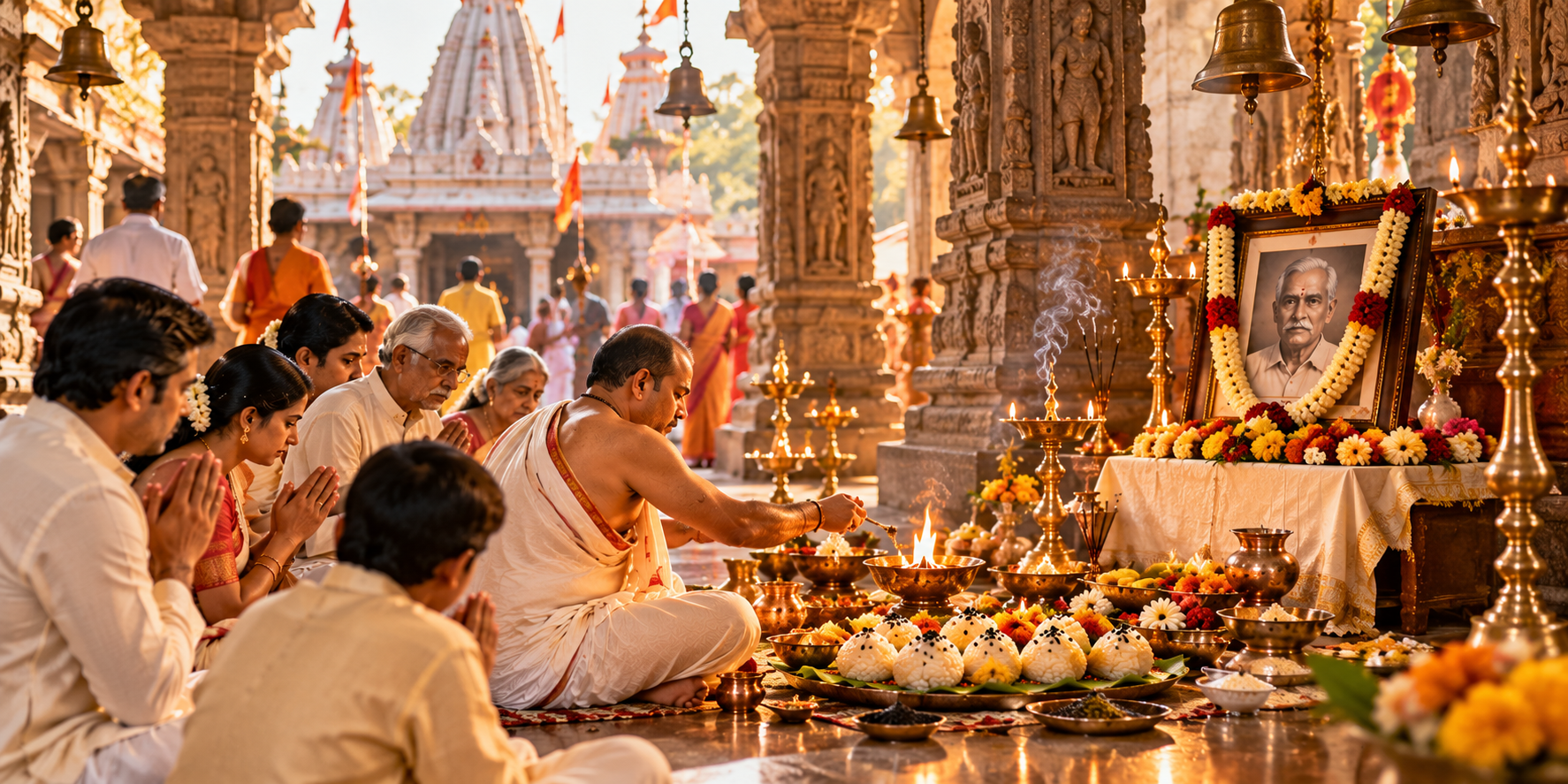
Pitru Paksha rests on a long textual history, from Vedic hymns addressed to the ancestors to detailed ritual manuals and Puranic stories. It also rests on a living oral tradition of retellings, regional legends and family explanations that do not always appear in any text.
This guide tries to hold both with care. It outlines the major textual sources, discusses the best-known stories and how to present them responsibly, and explains the key philosophical ideas and symbols. Throughout, it distinguishes between what is found in canonical texts, what comes from later retellings, and what is popular interpretation, because each has its own kind of authority and its own place in how families understand the rite.
Key takeaways
- Ancestral offerings are ancient: the Rigveda addresses the pitrs directly, and later texts describe Shraddha in great detail.
- The Bhagavad Gita mentions the offering of pinda and water (1.42) and names Aryaman as chief of the pitrs (10.29).
- The widely told Karna story is a later popular retelling; it is not found in the critical edition of the Mahabharata.
- Pitru Rina, the debt to the ancestors, frames Shraddha as gratitude and responsibility.
- Water, sesame, kusha and pindas each carry layered symbolic meanings rooted in text and custom.
1 of 20
Pitru Paksha in Hindu Tradition: Scriptural and Cultural Context
Offering to the ancestors is one of the oldest continuous practices in Hindu tradition. It appears in the earliest Vedic hymns, is systematised in the ritual manuals of the late Vedic period, is codified in the Dharmashastras, and is elaborated in the Puranas.
The specific practice of a dedicated fortnight, Pitru Paksha or Mahalaya Paksha, is described in Puranic and later ritual literature, which recommends Shraddha during the dark fortnight when the sun is in Kanya (Virgo). Over centuries it became a pan-Indian observance, though with strong regional flavours.
Culturally, the fortnight sits at a significant point in the year: after the monsoon harvest, around the autumn equinox, and immediately before Navratri. Its position between the end of the rains and the great goddess festivals gives it a reflective, transitional character.
Understanding Pitru Paksha well means seeing it as layered: part Vedic sacrifice, part household duty, part pilgrimage culture, part folk custom, and part personal remembrance. See a beginner's overview of the texts.
2 of 20
Shraddha in Hindu Textual Traditions: A Beginner’s Overview
A simplified map of the main textual layers:
Vedas
The Rigveda addresses the pitrs in several hymns, most fully in 10.15, inviting them to the sacrifice and asking for their favour. Offerings of cakes to the fathers (pinda pitr yajna) appear in Vedic ritual.
Upanishads
The Chandogya and Brihadaranyaka Upanishads describe two paths after death: the path of the gods (devayana) and the path of the fathers (pitryana), the latter leading to the world of the ancestors and eventually to rebirth.
Bhagavad Gita
Arjuna's lament (1.42) refers to ancestors falling when offerings of pinda and water cease, showing how central these rites were.
Sutras and smritis
The Grihya Sutras give ritual procedures. The Manusmriti (chapter 3) and Yajnavalkya Smriti discuss Shraddha at length, including timing, guests and food.
Puranas
The Vayu, Matsya, Vishnu, Garuda and other Puranas elaborate on Shraddha, Pitru Loka and sacred places such as Gaya.
Each layer builds on, reinterprets or adds to earlier ones, and regional practice draws selectively from them.
3 of 20
Garuda Purana and Shraddha: What Is Commonly Associated with the Tradition?
The Garuda Purana is closely associated in popular understanding with death and the afterlife, largely because of its Preta Khanda (or Pretakalpa), a section in which Vishnu instructs Garuda about the fate of the soul after death, the rites performed by descendants, and the realms of reward and punishment.
In many North Indian households, portions of the Garuda Purana are read aloud during the thirteen days after a death, a period of mourning and funeral rites. Its descriptions of the soul's journey, of Yama, and of the Vaitarani river are widely known.
It is important to be precise about what the Garuda Purana is and is not:
- It is primarily associated with post-death rites (antyeshti and the first year), not specifically with Pitru Paksha.
- It exists in several recensions, and the Preta Khanda's vivid descriptions of punishments are read by many as moral teaching rather than literal geography.
- Some families prefer not to keep it at home except during mourning, a custom rather than a textual rule.
Its themes, the soul's journey and the importance of rites by descendants, nonetheless inform how many families understand Shraddha.
4 of 20
Mahabharata and Ancestor Offerings: Stories Commonly Linked to Pitru Paksha
The Mahabharata contains substantial material on ancestral rites.
- Bhishma's teachings. In the Anushasana Parva, Bhishma instructs Yudhishthira on Shraddha, including suitable days, foods and recipients. He recounts that Nimi, grieving his son, was the first to perform Shraddha, and was reassured by the sages that it was a proper rite.
- Yudhishthira and Karna. After the war, Kunti reveals that Karna was her firstborn son. Yudhishthira, grief-stricken to learn he had fought his own elder brother, performs funeral offerings for Karna. This episode is part of the epic's text.
- Offerings after the war. The Stri Parva describes the Pandavas and the women of both sides offering water to the fallen, one of the epic's most moving scenes of collective mourning.
Other stories linked to Pitru Paksha in popular culture, especially the tale of Karna returning to earth for fifteen days, are later retellings rather than episodes in the critical text. See the story of Karna.
5 of 20
The Story of Karna and Pitru Paksha: Tradition, Meaning and Interpretation
The story as popularly told
After his death, Karna, renowned for his generosity, reaches heaven. When he is hungry, he is served gold and jewels instead of food. He asks Indra why, and is told that in life he gave gold generously but never offered food to his ancestors. Karna explains that he did not know who his ancestors were. He is allowed to return to earth for fifteen days to offer food and water to them, and this period becomes Pitru Paksha.
Its source
This story is widely told in sermons, articles and family explanations, but it does not appear in the critical edition of the Mahabharata. It is best described as a popular or regional retelling, whose origin is not clearly documented.
Its meaning
The story's power lies in its message: generosity is incomplete without feeding, and knowing and honouring one's ancestors matters. It also offers an explanation for the fortnight's length.
Presenting it responsibly
Tell it as "a popular story says", not "the Mahabharata says". See how to present stories responsibly.

6 of 20
Why Gratitude to Ancestors Is Important in Hindu Philosophy
Gratitude to ancestors runs through Hindu thought in several connected forms.
- Life as a gift. The body, family, language and inheritance each person receives come from those before them. Gratitude is the natural response.
- Duty and reciprocity. The idea of Pitru Rina, a debt to the ancestors, frames this gratitude as an obligation fulfilled through offerings and through continuing the family. See Pitru Rina.
- The five daily sacrifices. Classical texts list five duties for the householder, including pitru yajna, offering to the ancestors, alongside offerings to gods, sages, humans and other beings. Gratitude to ancestors is thus part of daily, not only annual, life.
- Cosmic interdependence. Many Hindu texts describe a web of mutual nourishment linking gods, ancestors, humans and nature. The Gita's description of beings sustaining one another through offering (3.10 to 3.12) expresses this.
In everyday terms, gratitude to ancestors cultivates humility, a sense of continuity, and care for those who will come after.
7 of 20
Pitru Rina: The Idea of a Debt or Responsibility to Ancestors
Pitru Rina means "debt to the ancestors". The Taittiriya Samhita states that a person is born with three debts: to the sages (rishi rina), repaid by study; to the gods (deva rina), repaid by worship and sacrifice; and to the ancestors (pitru rina), repaid by having children and, in later understanding, by offering Shraddha. Some texts add a fourth debt, to fellow humans.
The word "debt" can sound transactional, but most interpreters understand it as responsibility arising from what one has received. The ancestors gave life and lineage; descendants continue the family, honour its memory and care for its members.
In contemporary discussion, many people interpret Pitru Rina broadly: repaid not only through ritual and children but through living in a way that honours the family's values, caring for elders, and contributing to the next generation, whether or not one has children.
The idea also shapes Shraddha's tone. It is not an act of charity toward the ancestors but a fulfilment of a relationship, offered with respect.
8 of 20
What Is Pitru Loka? Traditional Concepts Explained
Pitru Loka is "the world of the fathers", the realm in which ancestors are traditionally believed to dwell after death.
Descriptions vary across texts, but common elements include:
- Location: often described as between the earthly realm and the heavens, and associated with the moon. The Upanishadic "path of the fathers" leads through the smoke of the funeral fire, the night, the dark fortnight and the southern course of the sun, to the moon.
- Rulers: Yama, lord of death and the first mortal to die, is associated with the ancestors; Aryaman is named in the Bhagavad Gita (10.29) as chief among the pitrs.
- Nature: ancestors in Pitru Loka are sustained by offerings from their descendants, which is why Shraddha is described as nourishing them.
- Temporality: residence in Pitru Loka is generally not understood as permanent; the ancestors may move on to rebirth or other states.
Different philosophical schools interpret these ideas differently, some literally, some symbolically. For many families, Pitru Loka is simply a way of saying that the departed remain connected to us.
9 of 20
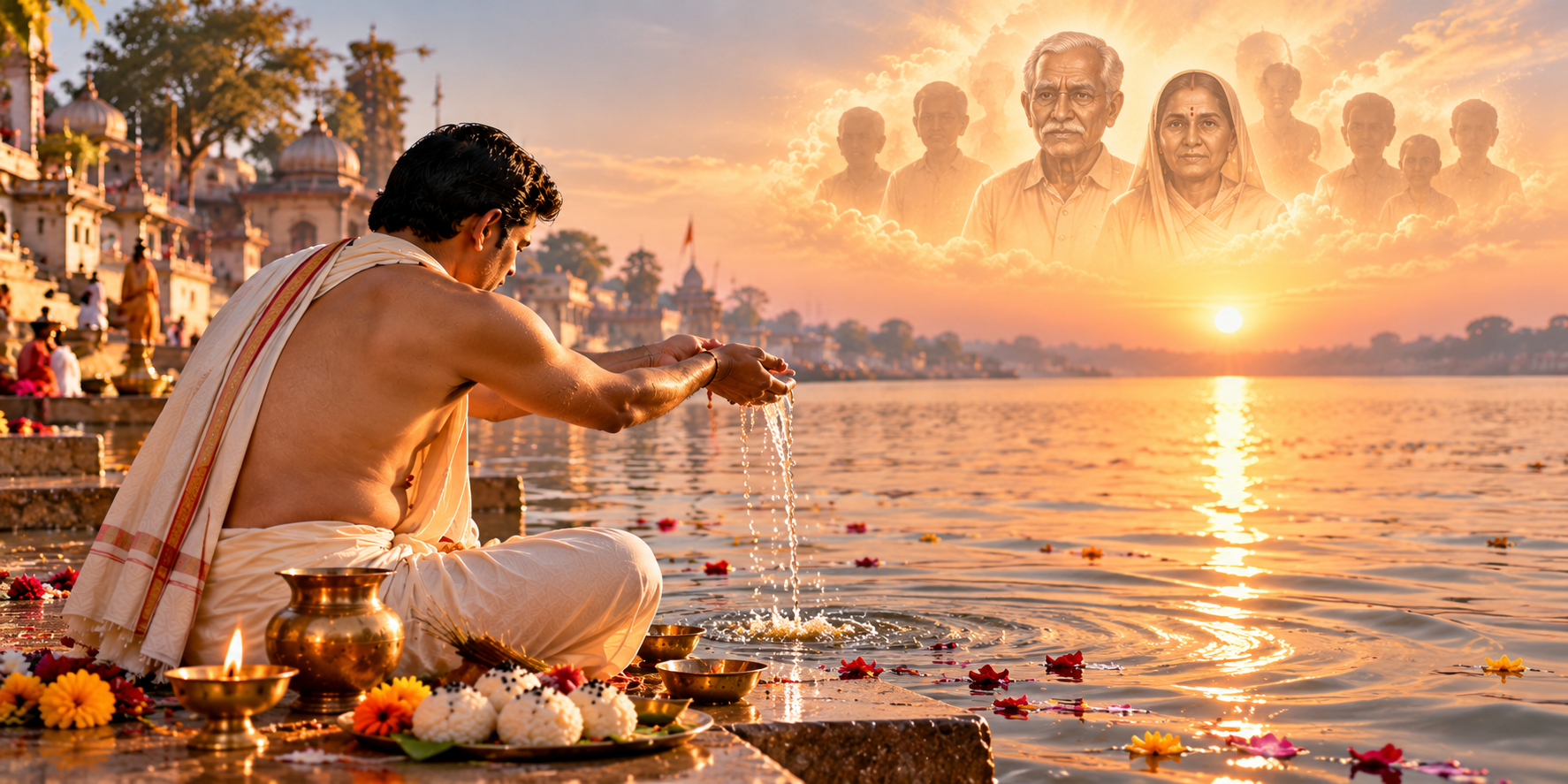
The Symbolism of Water in Ancestor Rituals
Water is the most elemental offering in Shraddha, and it carries several layers of meaning.
- Sustenance. Water satisfies thirst. Tarpan imagines the ancestors as receiving what the living cannot live without.
- Flow and passage. Rivers carry things onward, and tirthas, literally "crossing places", are often on rivers. Offering water into a river sends it toward the ancestors.
- Purification. Water cleanses body and space before the rite.
- Continuity. Water is poured through the hand in a continuous stream, like the continuity of generations.
- The Gita's concern. Arjuna fears that without pinda and udaka (water) offerings the ancestors fall (1.42), showing water's long-standing centrality.
The distinctive method, water poured over the base of the thumb (pitru tirtha) while facing south, marks the offering as ancestral rather than divine. See how water tarpan is offered.
10 of 20
The Symbolism of Sesame Seeds in Shraddha
Black sesame (til) is so bound up with ancestral rites that its presence alone signals a Shraddha.
Symbolic associations include:
- Origin in Vishnu. A traditional account says sesame arose from Vishnu's body (often described as from his sweat), making it sacred and purifying.
- Protection. Texts say sesame keeps away disruptive beings who might otherwise take the offering.
- Colour and direction. Its darkness is associated with the ancestors, with night, and with the south.
- Abundance. A single pod holds many seeds, and sesame yields oil, a symbol of nourishment and light.
- Imperishability. Some texts say offerings made with sesame become inexhaustible for the ancestors.
In practice sesame appears in tarpan water, pindas, food and daan. White sesame is used for deities in some rites, black for ancestors. See why sesame is used.
11 of 20
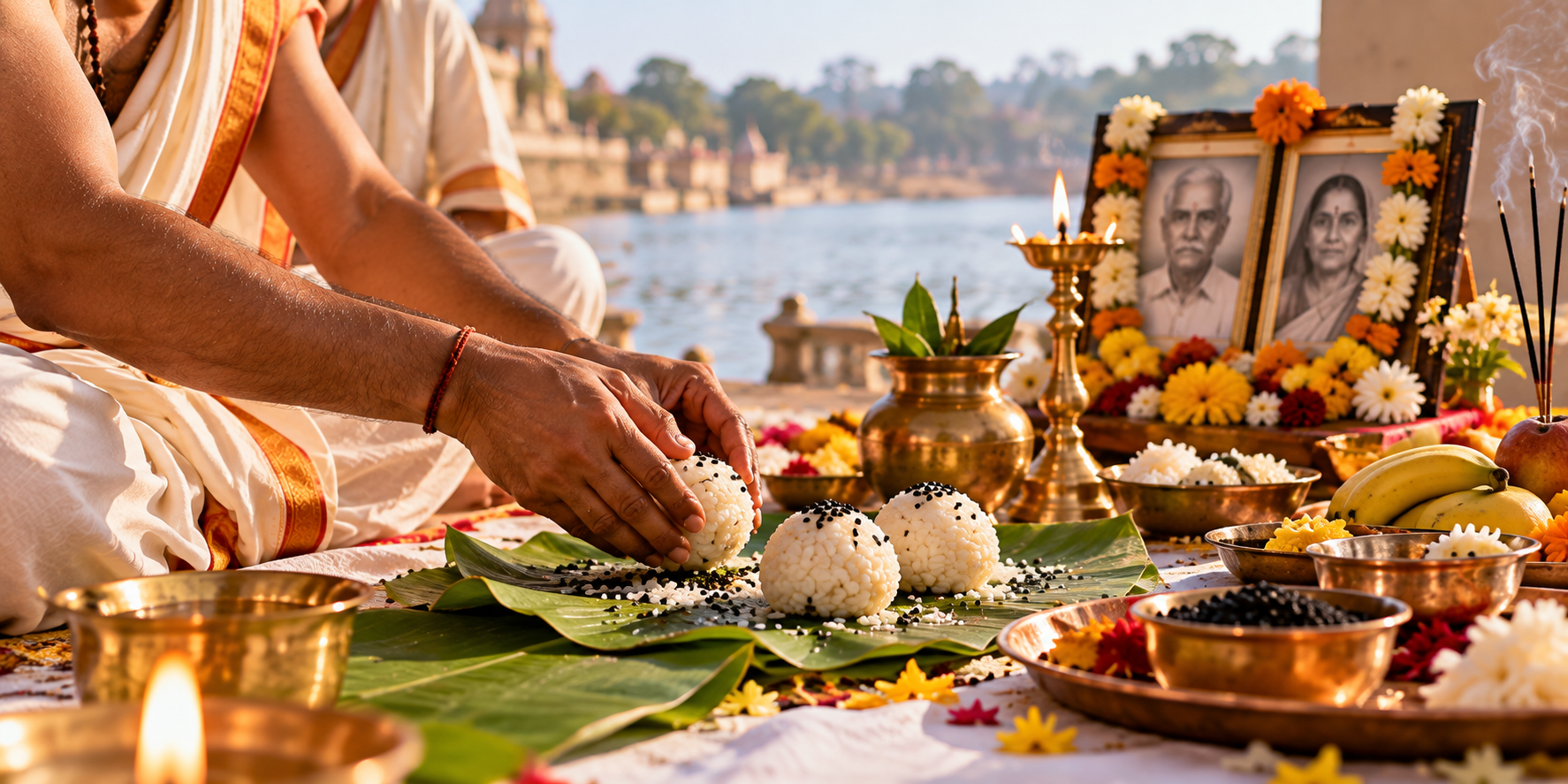
The Symbolism of Pindas in Pind Daan
The pinda, a ball of rice or barley with sesame and ghee, is rich in symbolism.
- Nourishment. At its most direct, it is food: grain, fat and sweetness offered to sustain the ancestors.
- A body. Many traditions describe the pindas offered in the days after death as forming a subtle body for the departed, allowing them to continue their journey. Pitru Paksha pindas continue this nourishment.
- Kinship. The word sapinda, "sharing the pinda", historically defined close kin: those connected through common ancestral offerings. The pinda thus embodies family itself.
- Wholeness. Its round form evokes completeness and the cycle of life.
- Offering into the earth. Pindas placed on kusha on the ground, then given to a cow, water or earth, return to the elements.
Some interpreters also note the resonance with the embryo, since pinda is also used for the body forming in the womb, linking birth and death in one image. See pind daan in practice.
12 of 20
The Symbolism of Kusha Grass in Ancestral Rituals
Kusha (darbha) is among the most sacred plants in Vedic ritual, and it is nearly indispensable in Shraddha.
Symbolic meanings include:
- Purity. Kusha is believed not to carry ritual impurity, so it is used to purify and to mark the ritual space.
- Sanctification by amrita. In the Mahabharata's Garuda story, the vessel of the nectar of immortality was placed on kusha, sanctifying it. (The same story explains why snakes, who licked the grass, have forked tongues.)
- Seat of the divine and the ancestors. Kusha spread on the ground forms the seat to which gods and ancestors are invited.
- Protection. Its sharp blades are sometimes read as a boundary guarding the offering.
- Readiness. The pavitri ring on the finger marks the wearer as ritually prepared.
The Bhagavad Gita (6.11) recommends a seat of kusha, deerskin and cloth for meditation, showing kusha's wider role in spiritual practice. See why kusha is used.
13 of 20
The Role of Memory and Lineage in Shraddha Tradition
Shraddha is, among other things, a technology of memory.
- Naming. Each rite names the ancestors, typically three generations on the father's side and often the mother's, with their gotra. Performed annually, this ensures that at least three generations are spoken aloud every year.
- Lineage. The gotra links the family to a founding sage, placing each individual within a long chain.
- Records. Pilgrimage priests at Haridwar, Gaya and elsewhere keep registers of visiting families, sometimes over many generations. These are some of the most remarkable genealogical archives in the world.
- Embodied memory. Recipes, gestures, clothing and ritual actions carry memory in the body, often better than words.
- Forgetting and inclusion. Sarva Pitru Amavasya acknowledges that some ancestors will be forgotten and includes them anyway.
In this light, Shraddha is not only an offering to the dead but a way for the living to know who they are. See family ancestor records.
14 of 20
Why Charity Is Connected with Ancestor Remembrance
Charity (daan) is woven into Shraddha at every level, and the connection has several roots.
- Textual. Shraddha texts repeatedly praise gifts made in the ancestors' names and describe feeding Brahmins and guests as reaching the ancestors.
- Merit. Tradition holds that punya, the merit of a good act, can be dedicated to others, including the departed.
- Hospitality. The guest is honoured as divine in Hindu ethics (atithi devo bhava); feeding guests during Shraddha extends that principle.
- All beings. Panchabali, feeding cow, dog, crow and ants, expresses care for the wider world.
- Moral logic. Remembering those who cared for us naturally turns into caring for others. The popular Karna story makes the point that generosity must include feeding.
For many families today, charity in an ancestor's name is the most meaningful part of the fortnight, and it connects the rite with living needs. See why daan is associated with Shraddha.
15 of 20
Dharma, Family and Ancestral Responsibility in Shraddha Traditions
In classical Hindu thought, Shraddha is part of the householder's dharma, the duties of someone living in family life.
This framing has several implications:
- Continuity. Shraddha is one of the ways the family, as an institution spanning generations, is maintained. The household is where gods, ancestors, guests and all beings are honoured.
- Roles. Traditional texts assign the rite to specific family members, typically sons, reflecting historical structures of inheritance and lineage. Modern families reinterpret these roles. See who can perform Shraddha.
- Care for elders. Honouring the dead is closely linked with caring for the living elderly. Many teachers stress that serving one's parents in life matters more than rites after death.
- Responsibility forward. The same dharma that honours ancestors asks each generation to raise and guide the next.
Understanding Shraddha as dharma rather than superstition helps explain why many families continue it even when their views on the afterlife vary.
16 of 20
Shraddha as Ritual vs Shraddha as Remembrance: Understanding Both Dimensions
People approach Shraddha with different emphases, and both are part of the tradition.
As ritual
The rite is an efficacious act: correctly performed offerings, with the right mantras, materials and timing, actually nourish and benefit the ancestors. This view is expressed in ritual texts and held by many priests and families.
As remembrance
The rite is an act of memory, gratitude and family bonding. Its value lies in what it does for the living: honouring, grieving, reconnecting, passing on identity.
Holding both
Most families hold both views to some degree. The Sanskrit word itself, from shraddha, faith or sincerity, suggests that the inner attitude is essential in either reading. A technically perfect rite performed without care is considered hollow; heartfelt remembrance without any offering is incomplete for many families.
Recognising both dimensions helps families with different views, such as observant grandparents and less ritual-minded grandchildren, to take part together. See remembrance beyond ritual.
17 of 20
How Regional Retellings Shape Pitru Paksha Stories
Many of the stories people associate with Pitru Paksha come not from Sanskrit texts but from regional retellings: vernacular Ramayanas and Mahabharatas, temple legends (sthala puranas), folk songs, and family storytelling.
Examples:
- The legend of Sita's pinda offering at Gaya and her curse on the Phalgu river is central to Gaya's local tradition. See Phalgu.
- Crows as ancestors' messengers is widespread in folk belief, with local stories explaining the link.
- Sanjhi, a folk art practice of Rajasthan, Braj and neighbouring regions in which girls make images on walls during the fortnight, carries its own songs and stories. See Rajasthan traditions.
- In Bengal, Mahalaya's association with the arrival of the Goddess shapes the fortnight's meaning. See Bengal.
These retellings are not "less authentic"; they are how the tradition lives. They are best presented with their source and region named, so readers understand where a story comes from.
18 of 20
Common Pitru Paksha Stories and How to Present Them Responsibly
A few principles for writers, teachers, parents and anyone retelling Pitru Paksha stories:
- Name the source level. Distinguish "the Rigveda says", "the Manusmriti prescribes", "a Puranic story tells", "a popular story says", and "many families believe".
- Avoid false attribution. Do not attribute popular stories, such as Karna's return to earth, to the Mahabharata's text.
- Acknowledge variants. Most stories exist in several versions; mention that others exist.
- Avoid fear-based framing. Stories of angry ancestors or curses can frighten children and vulnerable people. Emphasise gratitude and continuity.
- Respect other traditions. Regional customs are not errors to be corrected by a "standard" version.
- Be careful with caste and gender. Many texts reflect historical hierarchies. Present them accurately, and note where contemporary practice differs.
- Cite when writing publicly. For articles and teaching, name texts and chapters where possible.
Good storytelling keeps both the wonder and the honesty of the tradition.
19 of 20
Pitru Paksha Symbolism for Beginners
A quick guide to the most common symbols:
| Symbol | Common meaning |
|---|---|
| South direction | The direction of the ancestors and of Yama |
| Water (tarpan) | Sustenance, flow between worlds, purification |
| Black sesame | Purification, protection, association with the ancestors |
| Kusha grass | Purity, seat of the ancestors, ritual readiness |
| Pinda | Nourishment, subtle body, kinship |
| Crow | Messenger between worlds; acceptance of the offering |
| Cow | Nourishing mother; merit of giving |
| Lamp at dusk on Amavasya | Farewell and guidance for the ancestors |
| Sacred thread on right shoulder | Marks the rite as ancestral |
| Dark fortnight | Time associated with the ancestors |
| White clothes and flowers | Simplicity, mourning and purity |
Each symbol has further layers, explained in the sections above. Different regions may use different symbols or give them different emphases.
20 of 20
Scripture and Tradition FAQ: Understanding Shraddha Without Oversimplifying It
Is Pitru Paksha mentioned in the Vedas?
Offerings to ancestors are Vedic; the specific fortnight is described in later Puranic and ritual literature.
Does the Bhagavad Gita support Shraddha?
It refers to pinda and water offerings (1.42) and to Aryaman as chief of the pitrs (10.29). Interpretations of Krishna's broader teaching on ritual vary.
Is the Karna story in the Mahabharata?
Not in the critical edition. It is a popular retelling.
Do all Hindu traditions practise Shraddha?
Most do, though some reform movements and philosophical schools have questioned or reinterpreted it. The Arya Samaj, for example, historically rejected Shraddha for the dead while emphasising service to living parents.
Do I have to believe in Pitru Loka to observe Shraddha?
Many observers hold varied beliefs; the rite is also meaningful as remembrance.
Where can I read more?
Translations of the Rigveda, the Bhagavad Gita, the Manusmriti and the Garuda Purana are widely available; scholarly introductions to Hindu ritual give helpful context.
Frequently asked questions
Is Pitru Paksha mentioned in Hindu scriptures?
Ancestral offerings appear from the Rigveda onward. The specific fortnight of Pitru Paksha is described in Puranic and later ritual literature.
Is the Karna story about Pitru Paksha in the Mahabharata?
No. The story of Karna returning to earth for fifteen days is a popular retelling not found in the critical edition of the Mahabharata.
What does the Bhagavad Gita say about ancestors?
In 1.42 Arjuna fears that ancestors fall when pinda and water offerings cease, and in 10.29 Krishna names Aryaman as chief among the pitrs.
What is Pitru Rina?
The debt or responsibility to the ancestors, one of three debts with which a person is born according to the Taittiriya Samhita, traditionally repaid through offspring and Shraddha.
What is Pitru Loka?
The world of the ancestors, traditionally associated with the moon and with Yama, where the departed are believed to be sustained by their descendants' offerings.
Is the Garuda Purana read during Pitru Paksha?
It is mainly read during the thirteen days after a death rather than during Pitru Paksha, though its themes shape how many families understand ancestral rites.