Contents: 20 topics
- How to Perform Shraddha at Home: A General Step-by-Step Overview
- Tarpan: Meaning, Purpose and Traditional Procedure
- Pind Daan: Meaning, Symbolism and Traditional Practice
- Shraddha Puja Samagri List: Common Items and Their Purpose
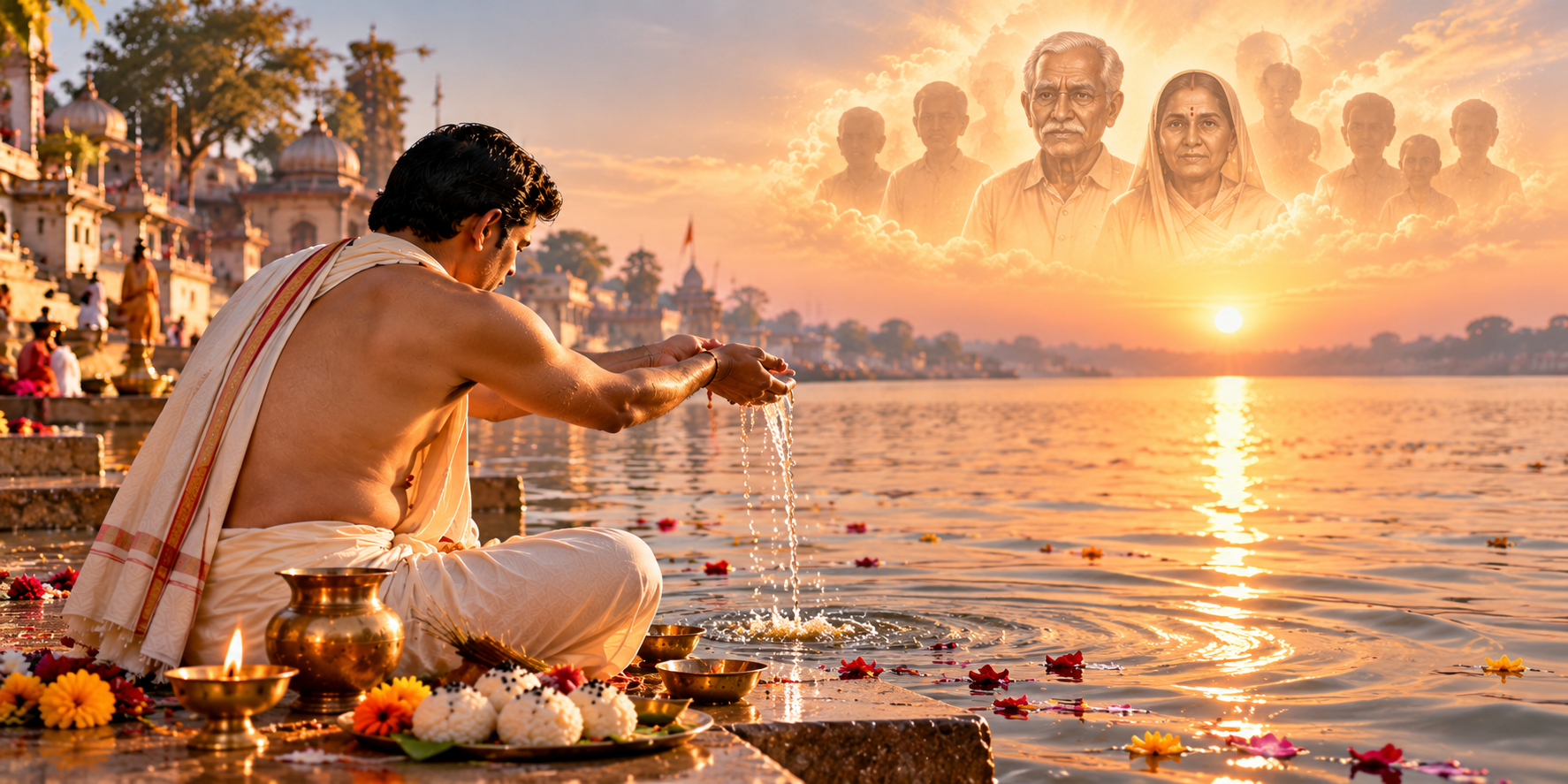
- How Water Tarpan Is Offered to Ancestors
- Til Tarpan: Why Sesame and Water Are Offered Together
- Pind Daan at Home vs Pilgrimage Site: Traditional Differences
- What Is Brahmin Bhoj in Shraddha Tradition?
- Why Is Charity or Daan Associated with Shraddha?
- Why Are Cows, Crows, Dogs and Other Beings Fed in Some Shraddha Traditions?
- How to Prepare a Simple Ancestor Remembrance Space at Home
- What Foods Are Commonly Offered During Shraddha?
- What Is Sankalpa in a Shraddha Ritual?
- Why Is the Ancestor’s Name and Gotra Used in Some Shraddha Rituals?
- Can Shraddha Be Performed Without Knowing Gotra?
- Can a Priest Guide Shraddha Remotely for Families Living Abroad?
- Shraddha Rituals for Multiple Ancestors: General Planning Guide
- How to Perform a Simple Tarpan When a Full Shraddha Is Not Possible
- What to Do Before, During and After a Shraddha Ritual
- Shraddha Ritual FAQ: Tarpan, Pind Daan, Offerings and Family Practice
- Frequently asked questions
A Shraddha can be as elaborate as a three-hour ceremony with several priests on the banks of the Ganga, or as simple as a few handfuls of sesame water offered on a balcony. Both are recognised. What connects them is a shared structure: an intention, an invitation to the ancestors, offerings of water and food, feeding others, and giving.
This guide explains that structure. It is written for families who want to understand what their priest is doing, for those performing a simple rite themselves, and for anyone adapting the tradition to a small home or a life abroad.
Key takeaways
- The core of Shraddha is sankalpa, tarpan, pind daan, feeding and daan.
- Ancestral offerings are usually made facing south, often with the sacred thread worn over the right shoulder, and water poured through the pitru tirtha between thumb and forefinger.
- Tarpan alone is widely accepted as a minimum observance when a full Shraddha is not possible.
- If the gotra is unknown, many priests use Kashyapa gotra; the ancestor's name and sincere intention matter most.
- Feeding a cow, crow, dog and ants (panchabali) extends the offering to all beings.
1 of 20
How to Perform Shraddha at Home: A General Step-by-Step Overview
This outline reflects a common household pattern. Take it as orientation, not prescription.
- Prepare. The performer bathes, wears clean, plain clothes (often white or unstitched cloth for men), and fasts or eats lightly until the rite is complete. The space is cleaned and the meal is cooked fresh.
- Set up. Sit facing south on a mat. Arrange water, black sesame, kusha, rice or barley flour for pindas, a lamp, flowers (often white) and the prepared food. Photographs of ancestors may be placed nearby.
- Sankalpa. State the intention, naming the date, place, your gotra and the ancestors being honoured. See sankalpa.
- Invocation. Ancestors are invited to seats of kusha.
- Tarpan. Water with sesame is offered for each ancestor. See how water tarpan is offered.
- Pind daan. Pindas are offered on kusha with prayers, if the family's tradition includes them. See pind daan.
- Feeding. Invited Brahmins or guests are served; portions are set out for cow, crow, dog and ants.
- Daan and dakshina. Gifts are given; guests are seen off respectfully.
- Conclusion. Ancestors are bid farewell, pindas are disposed of respectfully, and the family eats.
2 of 20
Tarpan: Meaning, Purpose and Traditional Procedure
Tarpan (tarpana) means "satisfying" or "giving contentment". It is the offering of water, usually mixed with black sesame and sometimes with barley, rice, flowers or kusha, to deities, sages and ancestors.
In the full daily practice described in many ritual manuals, tarpan has three parts: deva tarpan to the gods, rishi tarpan to the sages and pitru tarpan to the ancestors. During Pitru Paksha, the ancestral portion is the focus.
A common procedure: the performer faces south, wears the sacred thread (if worn) over the right shoulder in the position called apasavya or prachinavita, holds water with sesame and kusha in cupped hands, names the ancestor with their gotra and relationship, and releases the water over the base of the thumb, often three times per ancestor. The words used typically end with "tasmai svadha namah" or "tripyatam", meaning "may he or she be satisfied".
Tarpan can be performed in a river, at a tank, or at home into a vessel. It is often done every day of the fortnight, and it is the most widely accepted short form of Shraddha. See simple tarpan.
3 of 20
Pind Daan: Meaning, Symbolism and Traditional Practice
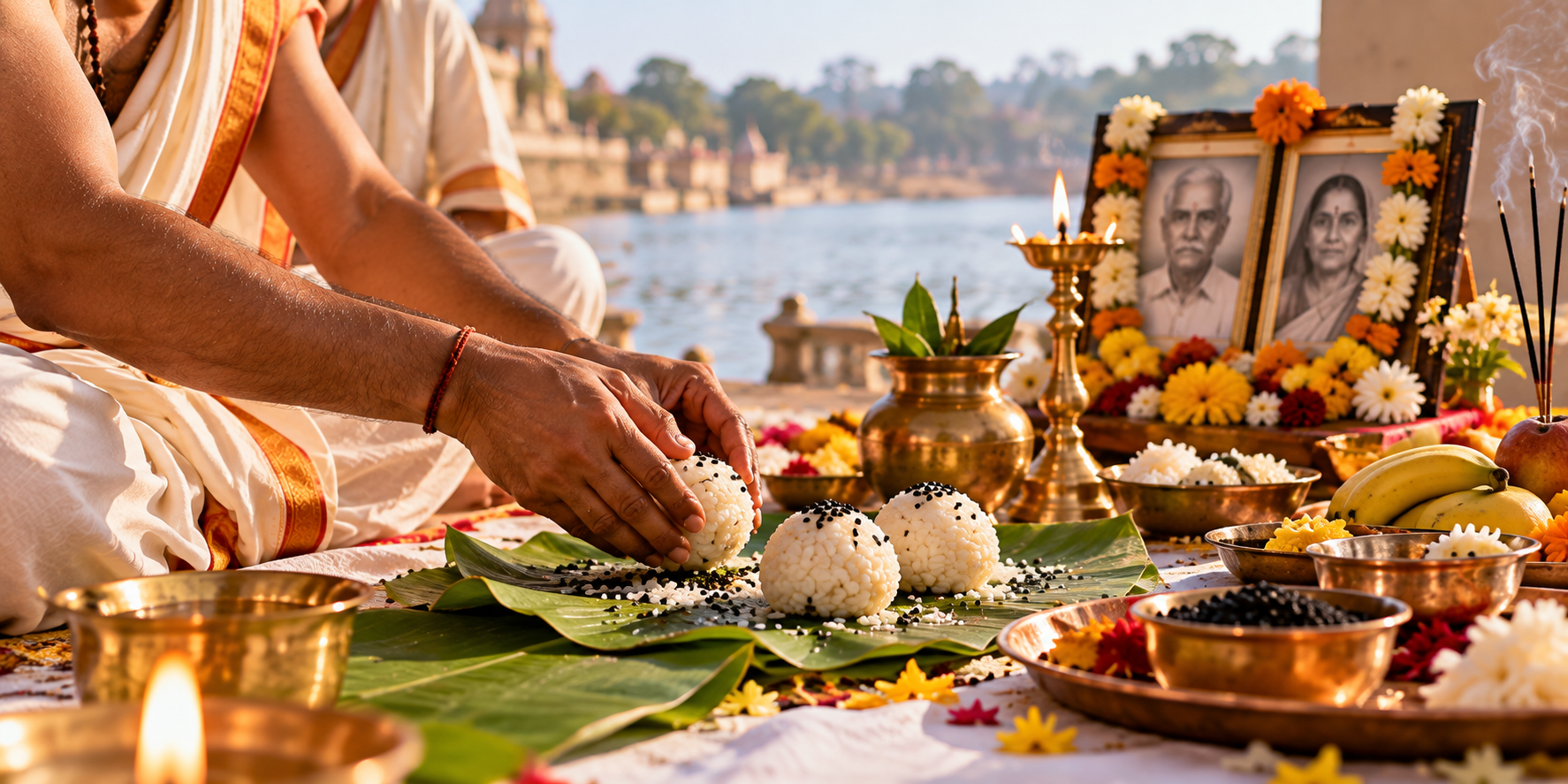
A pinda is a small ball of food, most often cooked rice mixed with black sesame, ghee and sometimes honey and milk, or balls of barley flour. Pind daan is the offering of these balls to the ancestors.
Traditionally, three pindas are offered for the three paternal generations (father, grandfather, great-grandfather) and, in many traditions, three for the maternal line, with additional offerings for the wider lineage and for any souls without descendants. They are placed on blades of kusha spread on the ground or on a leaf plate, with water, sesame and flowers.
The pinda is understood as a symbolic body of nourishment: the rice sustains, sesame purifies, ghee and honey sweeten. Some interpretations also connect it to the idea of sapinda, the kinship of those who share offerings, which historically defined the extended family. See the symbolism of pindas.
After the rite, pindas are traditionally given to a cow, immersed in flowing water, fed to fish or birds, or buried. Pind daan at Gaya holds a special place in tradition; see the Gaya guide.
4 of 20
Shraddha Puja Samagri List: Common Items and Their Purpose
Families and priests vary, but these items appear in most Shraddhas.
| Item | Purpose |
|---|---|
| Black sesame (til) | Mixed into tarpan water and pindas; associated with ancestors and purification |
| Kusha grass | Pavitri ring for the finger, seats for ancestors, base for pindas |
| Copper or brass vessel and a plate | For tarpan water |
| Clean water, ideally Ganga jal added | For tarpan and purification |
| Rice or barley flour | For making pindas |
| Ghee, honey, milk | Mixed into pindas and used in cooking |
| White flowers, tulsi leaves | Offerings; tulsi is widely used, though some families omit it |
| Sandalwood paste | Offering and tilak |
| Ghee lamp and incense | Light and fragrance |
| Janeu (sacred thread), if worn | Worn apasavya for ancestral rites |
| White cloth or dhoti | Clothing for the performer; also given as daan |
| Leaf plates or bowls | For pindas and food portions |
| Freshly cooked meal | For guests, animals and family |
| Dakshina and daan items | Money, grain, clothing, sesame, utensils |
Outside India, kusha and Ganga jal may be hard to find; temples often stock them before Pitru Paksha. Most priests accept substitutions made in good faith.
5 of 20
How Water Tarpan Is Offered to Ancestors
The manner of offering is what distinguishes ancestral tarpan from other water offerings.
- Direction. Face south, the direction associated with the ancestors and with Yama.
- Thread position. If a sacred thread is worn, it is shifted to the right shoulder (apasavya).
- Hand position. Water with sesame is held in the right palm, or both palms cupped, and poured out over the base of the thumb and index finger, the part of the hand called the pitru tirtha. Offerings to the gods, by contrast, are poured over the fingertips (deva tirtha).
- Kusha. A few blades held with the water, or worn as a pavitri ring, often accompany the offering.
- Repetition. Water is commonly offered three times for each ancestor, naming them each time, with a phrase such as "[name], [gotra], tasmai svadha namah" or "tripyatam".
- Where it goes. In a river, the water flows away. At home, it is poured into a vessel and later given to a plant, the base of a tree or clean earth, not down a drain.
If you do not know the mantras, naming the ancestor and saying in your own words that you offer this water with love and gratitude is widely considered acceptable.
6 of 20
Til Tarpan: Why Sesame and Water Are Offered Together
Til tarpan is simply tarpan in which black sesame is added to the water, and for ancestral rites it is the norm rather than a special variety.
The pairing brings together two of the most elemental offerings. Water satisfies thirst and carries the offering onward; sesame, in tradition, purifies, protects and nourishes. Texts say that sesame keeps disruptive forces from taking the offering and that its presence makes even a small offering complete. Its dark colour is also associated with the ancestors and the southern direction.
In practice, a pinch of sesame is placed in the palm or in the water vessel, and the mixture is released together. Some families use sesame and barley together; some add a few grains of rice or a flower.
Outside India, black sesame is widely sold in Asian grocery stores. If only white sesame is available, most families use it rather than omit the offering. See why sesame is used and the symbolism of sesame.
7 of 20
Pind Daan at Home vs Pilgrimage Site: Traditional Differences
The rite is essentially the same; what differs is setting, scale and the meaning families attach to the place.
At home
Pind daan at home is the everyday norm. It is usually offered for the three generations, with a family priest or by the family itself, and is repeated each year on the ancestor's tithi or on Amavasya.
At a pilgrimage site
At Gaya, Haridwar, Varanasi, Prayagraj, Badrinath and other tirthas, pind daan is often performed with a hereditary local priest (a panda or Gayawal) who may keep genealogical records of visiting families. Pilgrimage pind daan is considered especially meritorious and in some traditions, particularly at Gaya, is seen as bringing lasting satisfaction to the ancestors. Rites can extend over several days and multiple sacred spots.
Choosing
Many families perform home rites every year and a pilgrimage once in a lifetime or when a family event prompts it. Neither replaces the other. See pind daan at home vs Gaya and planning a pilgrimage.
8 of 20
What Is Brahmin Bhoj in Shraddha Tradition?
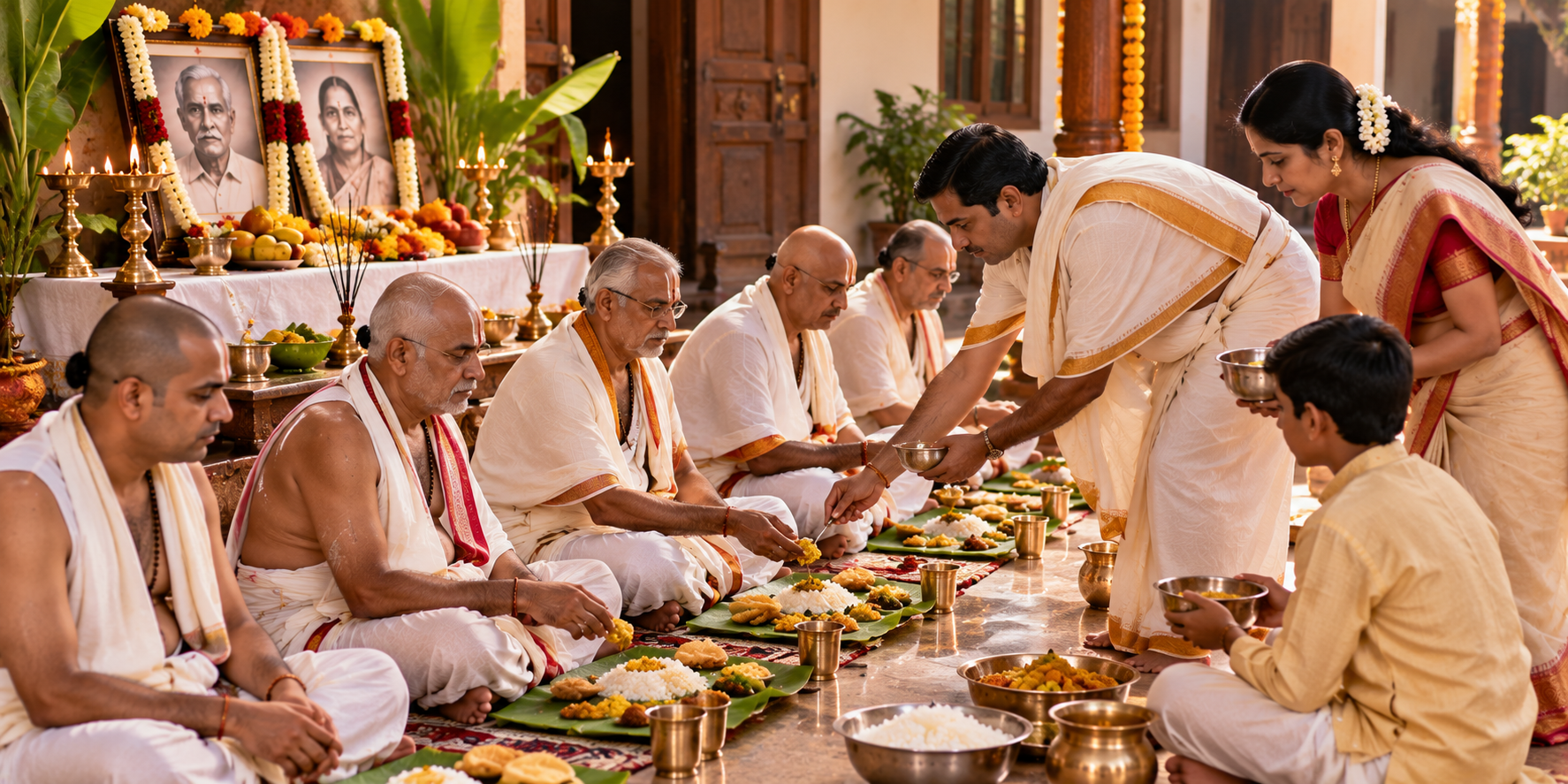
Brahmin bhoj (brahmana bhojana) is the feeding of invited Brahmins as part of Shraddha. In classical understanding, the Brahmins who eat the Shraddha meal act as representatives of the ancestors: what they eat with satisfaction is believed to reach the pitrs.
Traditionally, an odd number of Brahmins, often one or three, is invited. They are welcomed, their feet washed, and they are seated and served the meal in a calm atmosphere with minimal conversation, followed by dakshina (an honorarium) and often gifts of cloth or grain. The family eats only after the guests have finished.
In modern practice this varies a great deal. Some families invite the officiating priest alone; some invite elders, teachers or respected guests of any background; some give the meal to a temple, an ashram, a school or people in need instead. Many priests themselves encourage feeding the hungry as an expression of the same principle.
Whatever the form, the spirit is respectful hospitality: guests are served first, generously and without hurry. See feeding the needy.
9 of 20
Why Is Charity or Daan Associated with Shraddha?
Daan (giving) completes the Shraddha. Texts on ancestral rites repeatedly praise gifts made in the name of the ancestors, and many families see it as the most important way of extending their remembrance into the world.
Common gifts include food and grain, black sesame, clothing, footwear, umbrellas, utensils, a lamp, and money. Some families give items the ancestor used or loved. Traditionally, daan is given to the officiating priest and invited Brahmins, and to those in need.
The logic is that merit (punya) generated by giving in the ancestors' name benefits them, and that generosity itself pleases them. There is also a simple moral dimension: remembering one's own dead is naturally turned into care for the living.
Modern families often give to hospitals, schools, food banks, animal shelters or disaster relief in an ancestor's name, sometimes choosing a cause linked to the ancestor's life. See why charity is connected with remembrance and combining ritual, charity and remembrance.

10 of 20
Why Are Cows, Crows, Dogs and Other Beings Fed in Some Shraddha Traditions?
Before the family eats, many households set aside small portions of the Shraddha meal in a practice called panchabali, "five offerings":
- Go bali for the cow, honoured as a nourishing mother.
- Shvana bali for the dog, associated with Yama's dogs and with guarding the path of the departed.
- Kaka bali for the crow, seen as a messenger connected to the ancestors.
- Pipilika bali for ants and small creatures.
- Deva bali for the gods, sometimes given to fire or placed aside.
The idea is that a Shraddha is not complete if only humans are fed. The ancestors are believed to be pleased when all beings share in the offering, and the practice expresses a wider ethic of care that runs through Hindu thought.
Details vary: some traditions include a portion for guests or strangers, some omit one of the five, and cities often lack cows. Families adapt by feeding birds, street dogs and ants, or donating to a gaushala. See feeding cows and what is offered to crows.
11 of 20
How to Prepare a Simple Ancestor Remembrance Space at Home
A remembrance space for Shraddha need not be elaborate.
- Choose the spot. A clean corner of a room or balcony where the performer can sit facing south. Many families avoid the main prayer shrine for ancestral rites and set up a separate space.
- Clean it. Sweep and wipe the floor; some families sprinkle Ganga jal or water with tulsi.
- Lay a base. A mat or a low wooden seat for the performer, and a plate, banana leaf or cloth for the offerings.
- Place photographs of the ancestors if your family's custom allows; some families keep ancestor photos out of the puja room but bring them to the Shraddha space for the day.
- Light a lamp. A simple ghee or sesame-oil lamp, placed to the south, and incense.
- Gather the samagri listed above.
After the rite, return the space to ordinary use. Some families keep a small photograph and lamp through the fortnight. See creating an ancestor memory corner for a longer-term version.

12 of 20
What Foods Are Commonly Offered During Shraddha?
The Shraddha meal is vegetarian, freshly cooked and, in many households, free of onion and garlic. Beyond that, it reflects regional cuisine and family memory.
Common elements across North India include kheer (rice cooked in milk and sugar), puri, a seasonal vegetable such as pumpkin or bottle gourd, dal or kadhi, rice, and sometimes a sweet like halwa. In Maharashtra, gourd and colocasia-leaf preparations are traditional; in Tamil Nadu and Karnataka, meals may feature specific vegetables such as plantain, yam and pumpkin, with payasam; Bengali households prepare distinct Shraddha menus.
Many families also cook an ancestor's favourite dish, within the family's dietary customs.
Some items are commonly avoided in particular traditions, such as masoor dal, certain vegetables, or leftover and stale food. These lists vary widely; see foods commonly avoided.
For menus, recipes and practical planning, see the food guide.
13 of 20
What Is Sankalpa in a Shraddha Ritual?
Sankalpa is the formal statement of intention with which almost every Hindu rite begins. It answers the questions: who is performing this rite, when, where, for whom, and why.
In a Shraddha sankalpa, the performer, holding water, sesame and kusha in the right hand, typically states:
- the cosmic and calendar time: era, year, month, fortnight, tithi and weekday;
- the place, often described in traditional geography ("in Bharata-varsha, in Jambudvipa");
- their own name and gotra;
- the names, relationships and gotras of the ancestors being honoured;
- the purpose: to perform Shraddha for their satisfaction.
The water is then released. A priest usually recites the sankalpa on the family's behalf, asking for the names.
The essential point is clarity of intention. If you are performing a simple rite without Sanskrit, a sincere statement in your own language, "Today, on this Pitru Paksha Ashtami, I, [name], offer this tarpan for my father [name] and my grandparents", is understood by most priests as fulfilling the purpose.
14 of 20
Why Is the Ancestor’s Name and Gotra Used in Some Shraddha Rituals?
A gotra is a patrilineal clan name tracing descent from a sage, such as Kashyapa, Bharadvaja or Vasishtha. In ritual it functions as a family identifier.
Naming the ancestor together with their gotra and relationship to the performer does two things in the traditional understanding. It directs the offering precisely to the intended person, in the way an address directs a letter. And it places the ancestor within a lineage, affirming continuity across generations.
For a married woman, practice varies: many traditions use the husband's gotra after marriage, while some use her birth gotra, particularly in rites performed by her own natal family. Priests follow their tradition.
The names used are usually the full given name, sometimes with a customary suffix that varies by community, such as devi for women in many traditions.
If the gotra is not known, the rite can still be performed. See Shraddha without gotra.
15 of 20
Can Shraddha Be Performed Without Knowing Gotra?
Yes. Many families, particularly those several generations removed from rural India or with mixed backgrounds, do not know their gotra, and priests handle this routinely.
The most common convention is to use Kashyapa gotra. Tradition explains this by describing the sage Kashyapa as a progenitor of all beings, so anyone may claim descent from him when their own lineage is unknown. Some priests instead use the gotra of the family's guru or omit the gotra altogether.
What matters most, in the view of most priests, is naming the ancestor clearly and performing the rite with sincerity.
If you would like to discover your gotra, elders on both sides of the family, a hereditary priest at a pilgrimage site such as Haridwar (where pandas keep family registers), marriage documents or old horoscopes can sometimes help. See handling an unknown gotra and unknown tithi or gotra.
16 of 20
Can a Priest Guide Shraddha Remotely for Families Living Abroad?
Increasingly, yes. Since around 2020, many priests and temples have offered Shraddha guidance by video call, and families abroad commonly use it.
Two models are common:
- Guided at home. The priest recites the sankalpa and mantras over video, while a family member performs tarpan and offerings at home following instructions.
- Performed on the family's behalf. A priest at a temple or pilgrimage site in India performs the rite with the family's names and gotra, while the family watches live or receives a recording, and makes donations locally.
Opinions differ on the second model; some families and priests feel the descendant's own participation is essential, others accept a proxy rite, which classical texts also allow in some circumstances. Many families combine the two: a proxy rite in India and a simple tarpan at home.
Practical tips: agree the fee and what is included in advance, share names and gotras in writing, set up your space and samagri before the call, and account for the time difference. See online Shraddha.
17 of 20
Shraddha Rituals for Multiple Ancestors: General Planning Guide
Most families honour more than one ancestor during the fortnight. A few principles help.
- Separate tithis, separate days. Where parents or grandparents died on different tithis, many families perform each Shraddha on its own day.
- Shared tithis, one rite. If two ancestors share a tithi, they are honoured together, each named individually.
- The standard three generations. A full rite usually names father, grandfather and great-grandfather (and often the corresponding mothers), and in many traditions the maternal grandfather's line as well.
- Everyone else on Amavasya. Uncles, aunts, siblings, friends and those whose tithi is unknown are commonly included on Sarva Pitru Amavasya.
- Mothers on Navami. Some families honour mothers who died as married women on Matru Navami.
Write a list before the fortnight, grouped by day. Include each person's name, relationship, gotra and tithi. This list, kept year to year, becomes a valuable family record. See multiple ancestors on the same day and writing a family record.
18 of 20
How to Perform a Simple Tarpan When a Full Shraddha Is Not Possible
When time, health, distance or circumstance prevent a full Shraddha, a simple tarpan is widely accepted as a sincere observance.
- Bathe and wear clean clothes.
- Sit facing south with a vessel of clean water, a pinch of black sesame and, if you have it, a few blades of kusha.
- State your intention: your name, the day, and the ancestors you are remembering.
- For each ancestor, take water and sesame in your right palm and let it flow over the base of your thumb into a second vessel, three times, saying their name and "may you be satisfied" or "svadha" as you do.
- Offer a short prayer, a moment of silence, or a memory.
- Pour the collected water onto a plant, a tree or clean earth.
- If you can, feed a bird or animal and give something to someone in need that day.
This takes about ten minutes and requires no priest. Many families perform it every morning of the fortnight in addition to any fuller rite. See tarpan at home vs riverbank.
19 of 20
What to Do Before, During and After a Shraddha Ritual
Before
- Confirm the tithi and time; arrange a priest if needed.
- Many performers eat a single simple meal the day before and fast until the rite is complete.
- Keep the kitchen clean and cook fresh; avoid tasting the food before it is offered.
- Bathe, wear clean plain clothes, and avoid haircuts or shaving on the day if that is family custom.
During
- Maintain a calm, unhurried atmosphere; keep conversation minimal.
- Serve guests first, generously, and do not press them to leave.
- Set aside portions for animals before the family eats.
After
- Give dakshina and daan; see guests off respectfully.
- Dispose of pindas and leaf plates respectfully: to a cow, into flowing water where permitted, or by burying.
- The family eats together, often sharing memories of the ancestor.
- Many families avoid celebrations for the rest of the day.
20 of 20
Shraddha Ritual FAQ: Tarpan, Pind Daan, Offerings and Family Practice
Is tarpan enough without pind daan?
For many families, yes, especially for daily observance or when a full rite is impractical. Priests generally regard sincere tarpan as a valid minimum.
What time of day should Shraddha be performed?
Traditionally around midday or the early afternoon (the kutup and aparahna periods). Morning tarpan is also common. See timing.
Can Shraddha be done at night?
Traditionally it is avoided after sunset. If circumstances force it, many families perform tarpan at the next suitable time or on Amavasya.
What happens to the pindas?
They are given to a cow, immersed in flowing water, fed to fish or birds, or buried.
Do I need to fast?
Many performers fast until the rite is complete. Those with health conditions are not expected to.
Can I use a photograph of the ancestor?
Many families do. Some keep photographs away from the main shrine, but bring them to the Shraddha space.
Frequently asked questions
What is the difference between tarpan and pind daan?
Tarpan is the offering of water, usually with black sesame. Pind daan is the offering of rice or barley balls (pindas). A full Shraddha usually includes both.
Which direction should I face during Shraddha?
South, the direction traditionally associated with the ancestors.
What should I do if I do not know my gotra?
Many priests use Kashyapa gotra when the family gotra is unknown. The ancestor's name and sincere intention are considered most important.
Can a priest perform Shraddha online for my family?
Many priests and temples offer video-guided rites or perform Shraddha on a family's behalf. Opinions differ on proxy rites, so many families combine one with a simple tarpan at home.
What is panchabali in Shraddha?
The setting aside of food portions for five recipients: the cow, the dog, the crow, ants and small creatures, and the gods.
Is a simple tarpan acceptable if a full Shraddha is not possible?
Yes. A sincere tarpan with water and sesame, naming the ancestors, is widely accepted as a minimum observance.